Monday, 31 October 2016

Peru Part I - Lima to Cusco

We arrived in the capital Lima after an epic 36 hour bus journey! The extra cost to upgrade to VIP seats was well worth it. More legroom, wider seats and a personal TV like being on a plane. We stayed in the upmarket and trendy district of Miraflores, which could fairly easily fit into any European or US city. During our 2 day stay we visited a pre-Incan Huaca (temple), explored downtown Lima on a walking tour and cycled along the cliff tops of Miraflores. On our second night we treated ourselves to some gourmet Peruvian food and ate at the Panchita restaurant.

The cliffs of Miraflores

The following day was Ben's birthday and we decided to do something a bit different and celebrate by spending half the day on another bus! We had booked to travel from Lima to Cusco with Peruhop. This is a hop-on hop-off tourist bus that runs in the south of Peru (and connects to Bolivia). Whilst a bit more pricey than the standard long distance buses, they make stops at places that are otherwise harder to get to, include some tours in the price, have an English speaking guide and provide an opportunity to meet other travellers. Our first brief stop was on the outskirts of Lima at a memorial to those who died in the Pacific War between Peru and Chile at the end of the 19th Century. Here we learnt some history and got our first taste of the rivalry that still exists today between Peru and Chile. Mid-afternoon we arrived in the beach town of Paracas. The hostel here backed onto the beach and had a great terrace with a pool, pool table, table tennis and a bar. The perfect place for a birthday cocktail! We spent quite a bit of time just relaxing in the nice surroundings. Whilst in Paracas we also went sea kayaking and took a boat trip to Las Islas Ballestas where we saw thousands of seabirds including a couple of penguins. Due to the huge number of birds there is also a lot of guano (bird poo) which is harvested for use as fertiliser every 7 years.

Islas Ballestas boat trip

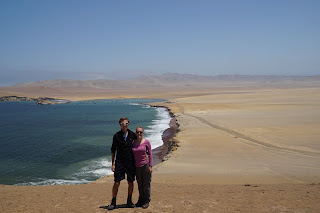
In the Paracas National Reserve

Our next stop was the desert oasis of Huacachina. This is a tiny village surrounding an oasis and only really exists now to cater for tourists both international and Peruvian. There isn't much to do here so we only spent 2 night, but the highlight was a dune buggy trip into the desert. The only word to describe this experience is crazy! The buggy was basically a huge engine, some steel tube fashioned into a chassis / roll cage, some seats and 4 huge wheels. It was like being on a roller coaster but with no track to make sure you stay in the right place. Our driver clearly had done this hundreds of times before and was very relaxed throughout the whole trip (the rest of us were slightly less so). We also had a short go at sand-boarding down some of the dunes. We tried to stand up on the shorter ones and used them as sledges for the huge steep ones.

'Driving' the dune buggy

In nearby city of Ica we visited the regional museum to find out more about the pre-colonial history of the area. Amongst lots of pottery and textiles they had several mummies and human skulls on display. The skulls had evidence of trepanning, which is where holes were cut in the skull (whilst the patient/victim was still alive) in order to let bad spirits out or allow better communication with the spirit world. It was very interesting, if a little creepy seeing so many human skulls. We also visited a Pisco winery before leaving the area. Pisco (distilled wine) is the national drink and a source of much pride for all Peruvians. It is often combined with egg white and lemon juice to make the famous Pisco Sour cocktail. Pisco is also the source of yet more rivalry with Chile, as both claim ownership of the drink and say that the other nation's drink isn't 'real' Pisco.

Hopping back on to the bus again we drove to Nasca - home of the famous Nasca lines. These are images carved into the earth by ancient civilisations. No-one really knows what they are for, most probably some sort of calendar, but with the largest being over 100m long there is no way they would have been able to appreciate their efforts (unless they invented flight and then kept it a secret!). As it is so hot and dry the weather doesn't seem to have affected them so they lay undiscovered for hundreds of years. They are so hard to spot from ground level that when building the Panamerican Highway in the area they built the road right through the middle of the lizard! We didn't think our stomachs would be strong enough to cope with a tiny aeroplane zipping over them, so settled for a tall look out tower where we could see a small section. Even this tiny glimpse was impressive, and so mystifying!

The next 'hop-off' point was in Arequipa. A pretty town with a backdrop of volcanoes situated in the foothills of the Andes at 2300m above sea level. Here we began what would be almost a month at high altitude with Arequipa being the lowest point!  From here we set off for a 3 day trek into the Colca Canyon. The Colca Canyon is the second deepest in the world, being twice as deep as the Grand Canyon in the USA. The measuring and defining of canyons is not exactly agreed upon worldwide so the second deepest claim may not be verified internationally. Nonetheless a trek down to the bottom, along part of it and back up to the rim was to be no mean feat and would serve as good practice for our upcoming Inca Trail trek. Day 1 started at 3am with a 5hr drive to the canyon, but we were rewarded with amazing views from the edge on arrival. We even got to see several condors effortlessly gliding over the canyon. The trek on the first day was almost entirely downhill into the canyon, but still hard work due to the intense heat. Needless to stay the views were stunning for the whole trek and words here can't really do them justice.
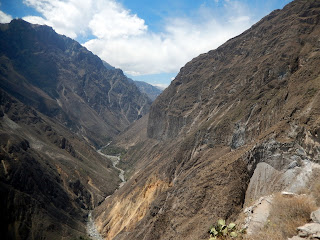
A view of Colca Canyon from halfway down

Day 2 began at the more leisurely time of 7am after a breakfast of pancakes. We walked along the canyon passing through a couple of small villages stopping occasionally for our guide to explain various things to us. We learnt about the culture and traditions of the local Quechua people, and interesting facts about the flora and fauna.

Canyon supermarket selling the essentials of water and snacks

Our accommodation for the second night was in a small oasis where we had tasty food and went for a much needed swim in a pool filled with water from a mountain spring. Cold, but refreshing.

The second night was spent in basic thatched huts

The third and final day consisted of the uphill climb out of the canyon. This was the equivalent of climbing up Ben Nevis, but we were already twice as high when at the bottom! We started walking in the dark with head torches to light our way so that we would avoid hiking in the the mid-day heat. We kept the pace slow as we weren't fully used to the altitude yet and made it to the top in under 3hrs. Some of our group elected to use mules to get to the top and overtook us just before the top despite setting off over an hour later. On the drive back to Arequipa we stopped at some natural hot springs where we spent a relaxing hour. The water had to be mixed with cold water before anyone was allowed in as it was literally boiling as it came out the ground. It was very strange to see a spring of boiling water.

Victory banana!

After one night back in Arequipa we got back on the Peruhop bus for the journey through the Andes to the Inca capital of Cusco, where we would meet Fiona's sisters and our friend Gawaine for more adventures.


Monday, 3 October 2016

Ecuador

We arrived in Ecuador on 6th September after a night bus from Cali in Colombia to the border. After the usual slow land border crossing; a long queue to get out of out Country A, a short walk across no-man's land, and a slightly shorter queue to get into Country B, we had arrived in the second country on our travels.  Despite everyone having their bags searched for drugs in Colombia before we boarded the bus and again on arriving in Ecuador, the bus was pulled over by anti-narcotics police less than 5km into Ecuador. Fortunately this time they only picked on random people and we weren't chosen, but it was a bit nerve wracking nonetheless.

Quito, the second highest capital city in the world at 2850m, was our first stop. We stayed at the really good Secret Garden Hostel where we had pancakes for breakfast and lasagne/pie for dinner. The food was a welcome change from the rice/meat combo prevalent in Colombia. The highlight of our stay in Quito was a trip to the Equator which is just north of the city. The bus took about 90mins and cost us less than $1 for us both! Ecuador in Spanish just means Equator so the line is known as El Mitad del Mundo; The Middle of the World. There is a large park and monument where we took the obligatory photos and stepped back and forth from the Northern to Southern Hemispheres. 

Ben at Mitad del Mundo

However the monument is actually in the wrong place! The equator was 'accurately' measured in 1982 and the monument built accordingly. With the advent of GPS technology we now know that the Equator is 240m further north. (NB: The Equator actually moves due to the Earth not being a perfect sphere and other reasons. Google it if interested). There is another small museum next to the larger one where they also claim to have the Equator. We learnt a bit about indigenous cultures in Ecuador, saw some shrunken heads and balanced an egg on a nail (apparently it's easier on the Equator but I don't believe it). The guide also demonstrated to us how water will spin anti-clockwise out of a sink in the Northern Hemisphere and clockwise in the Southern Hemisphere. Again this is a fallacy and can easily be done as a trick anywhere in the world. I'll leave interested parties to use Google again for more info.

Fiona and her egg

From Quito we headed to stay just outside the Cotopaxi National Park. The Secret Garden also own a hostel there which was amazing. We stayed 3 nights in the middle of nowhere absorbing the stunning scenery. Due to it's remote location the hostel is all inclusive so everyone sits down for meals together making for a great social atmosphere. We made some good friends in our short time there. The hostel is at an altitude of 3500m which makes even the shortest of walks more breathless than they should be. 

Our home for 3 nights in Cotopaxi. No power, just a log burner to keep warm.

Our first two days were spent doing a short hike to a waterfall, a hike up to the summit of Pasochoa, an extinct volcano at 4200m and playing card games in the evening. Cotopaxi itself is an active volcano and last erupted from August 2015 to January 2016. The national park had only just re-opened and attempts at the summit are still prohibited. Instead we drove up to the last car park and hiked for 40mins in the snow and wind to the refuge at 4864m. The whole climb was up volcanic sand which made for difficult time even without the altitude. After a quick cup of tea we headed back down to the minibus and then mountain biked down the lower slopes to the exit of the park. The terrain was like nothing we had experienced before and looked like it belonged on a different planet or distant moon. The huge boulders bigger than cars strewn about demonstrated the awesome power of the volcano. We would happily have spent much longer in the area climbing other volcanos and enjoying being completely isolated from the rest of the world.

 Cotopaxi Volcano

 At the refuge after a tough hike

Making friends with the locals

From Cotopaxi we headed to the adrenaline capital of Ecuador - Baños. This is a tiny town on a plateau at the foot of another volcano - which we were made very aware of by all the volcano evacuation posters in every room of our hostel. (Fortunately there were no signs of eruption during our stay). Despite it being cold and rainy when we arrived, it was much sunnier the next morning - perfect weather for hiring bikes (guess who's idea that was!). We chose a route out of the town passing by several local waterfalls which were very picturesque. The final one was huge and if you were feeling brave (and didn't mind getting wet) you could crawl up a tunnel in the rock to stand behind it! After a morning of cycling we had earned a good lunch in a well placed empanada shop. The banana and chocolate ones were amazing! Later that evening we treated ourselves to a rather extravagant spa session in a local hotel. Situated half way up the mountain, we enjoyed beautiful views over the whole of Baños, both before and after the sunset, while lounging in a series of hot pools and jacuzzis. (They also had amazing showers!).

Ben in the Devil's Cauldron

During the next few days in Baños the fun really started as we went white water rafting, canyoning (abseiling down waterfalls) and went on the swing at the end of the world. This is a swing from a treehouse high up on the mountain side, enabling fantastic pictures of the view. When we got there however the clouds had set in so instead we swung out over mist. Still got some good pictures though. 

White Water Rafting

Fiona on 'The swing at the end of the world'

From Baños we headed back up to Quito (via a short stop in Latacunga where we didn't do anything due to illness). Here we enjoyed our final few days in Ecuador, wandering around the old town streets and mentally preparing for our mammoth bus journey to Lima. But more about that in the next installment....

Friday, 16 September 2016

Colombia

Colombia was an amazing country in which to begin our adventure. 3 weeks went so fast and we feel we barely scratched the surface of this enchanting country. From the cool heights of Bogotá to the sticky heat of Cartagena and the bustle of Medellín we were captivated by the varied scenery and the friendliness of the people. 

Yes, Colombia has had a troubled recent history with terrorism, the war on the drugs and political turmoil taking a heavy toll on the country in the second half of last century. Since 2000 huge improvements have been made in security, the economy is booming and significant social reforms have been and are being made. It is now one of the more liberal countries in Latin America; one where gay marriage and same sex adoption are legal and fully legalising abortion is being seriously considered. We didn't feel any less safe than other more commonly visited backpacking destinations.

We began our Colombian adventure in Bogota on the 15th August. We stayed 3 nights in the Masaya hostel in the Candelaria area of the city. This is the old colonial part of the city with narrow streets and low buildings. None of the buildings look like much from the street but many go back a long way and have beautiful courtyards in the middle. The first morning we went on a Graffiti tour of the city, which was a great way to get our bearings and the art was amazing. A lot of the graffiti is the usual tags you see in any city, but that’s not what we went to see. Whole sides have buildings have been transformed by huge works of street art, some with political and social messages, others not, but all brightening up the neighbourhoods. The Colombians love their bikes, so a bike tour of the city seemed a fitting way to see more. Every Sunday half of the streets in the city are closed to all motorised traffic and Bogotans spend the day walking and cycling around the city. Our guide showed us parts of the city we wouldn’t have otherwise seen, including a visit to a fruit market, where we tasted several fruits we’d never seen before, and to a coffee roasting factory. We also visited the Museo d’Oro to see examples of pre-hispanic gold ornaments and jewellery and took a trip in a cable car to one of the mountains overlooking the city.

Amazing street art in La Candelaria

Arriving in Villa de Leyva, a beautiful old colonial town with narrow cobbled streets, we finally found some Colombian sunshine. Having arrived in the evening, we set off eagerly the next morning to climb up to a mirador (viewpoint) on a mountain side. Half way up we realised it was actually really quite hot, and much steeper than we realised! After a couple of water stops to 'look at the view' we successfully reached the top, and enjoyed the stunning vista out over the town and surrounding countryside, before heading down and straight back to the hostel to change into our shorts! The town seemed to be a hub of kite flying fanatics. In the main square every early evening people of all ages would come out in force with a variety of kites all different colour and shape. This was a very relaxing spectator sport, particularly as the square got busier and strings began crossing and getting tangled. The locals were obviously experts however as they usually got them untangled quickly with minimal frustration. 

Plaza Major in Villa de Leyva

Continuing our journey north we stopped in San Gil where we abseiled down a waterfall (Fiona even enjoyed it!), made a day trip to the colonial village of Barichara and had a very tasty burger. Leaving San Gil we took our first overnight bus journey to get to Santa Marta on the Caribbean coast. 10 hours at night on a bus sounds an uncomfortable experience, but long distance buses in South America are much better than those at home. With no train system and car ownership quite low, buses are the main method of transportation. The seats are comfy, tilt back close to horizontal and there is decent leg room (important when you are over 6ft). The first 2hrs of the journey to Bucaramanga were over a mountain pass, which was very windy and included some dubious overtaking manoeuvres. After that we were on the flat and got a pretty good night’s sleep awaking just in time to arrive in Santa Marta.

The heat and humidity of the Caribbean was a big change from the cool heights of Bogota and Villa de Leyva. We spent a couple of days at the beach and by the pool in the hostel enjoying the sun. A day trip to Tayrona National park was the highlight of our time in the area. Arriving mid-morning we paid our entry fee and began our hike through the jungle to reach the coast. The walk was hard work in the 35oC heat, but worth it for the amazing scenery. Following the path as it wound its way through the forest, we walked through tunnels of tree branches, over huge roots and up boulder covered climbs. We got a sneak peek of the sea from the top of one hill, only to plunge back down into the trees once again. After an hour we arrived at the coast and walked along the beach in the shade of the trees to find somewhere to swim. Emerging from the trees to hit the sand was a great experience. On the return journey we were lucky enough to first hear and then see a howler monkey high up in the canopy above us (the noise it could make was pretty impressive!).

Ben in Tayrona National Park

Our time spent in Cartagena felt much more like a holiday than travelling. The old town is still completely encircled by city walls and on the first night we wandered along them where we found a perfectly situated (but slightly pricey) bar to watch the sunset. As the port town was the first place the Spanish invaded and settled, it had much more of a Mediterranean feel to it. The port obviously still brought wealth to the area, as on the horizon beyond the old town was a very modern city dominated by skyscrapers.

Cartagena at night

Fiona at Castillo San Felipe de Barajas

The heat and humidity of the city drove us to book a trip out to the Islas de Rosario (a collection of islands just off the coast) and Playa Blanca - supposedly one of the most beautiful beaches in Colombia. With its long stretch of white sand and crystal clear blue sea I can certainly see why it got this reputation. However in many ways its success has also been its downfall and it is now covered with loungers, parasols, restaurants and ladies offering you massages (incredibly persistently!). Still, it did us well for the day, and we enjoyed swimming in the sea. The calmness and lack of waves is totally deceiving however, almost allowing me to almost forget the trauma of nearly capsizing on the way back to Cartagena... A highlight of our time in the city was a Chiva bus tour. A Chiva bus is a brightly painted old bus with wooden benches for seats and an onboard live salsa band. We drove around the city at night drinking rum and coke, partaking in dance offs, discussing the finer details of Brexit with Mexicans, and dancing the night away to Shakira and Enrique on repeat. So much fun!

Fiona on Playa Blanca

Our second overnight bus took us to the bustling city of Medellín, the home of the most infamous drug lord in history, Pablo Escobar. Fortunately for us he was killed in 1993 and the cartel's grip on the city has long since loosened. We stayed in a great hostel run by a Kiwi in the El Poblado district of the city. Another great walking tour helped us familiarise ourselves with the city whilst teaching us more about the city's (and country's) history and culture. Unlike the capital Bogotá, which is a sprawling mass and quite difficult to get around, Medellín has a metro system meaning you can get from the outskirts to the centre in 30mins. This was opened in 1995 and is seen as the symbol of the city. It bridges very poor and very rich areas of the city, and has helped increase tourism and business investment in the city. More importantly it includes 2 cable cars! Medellín is a pretty hilly city and the standard train based system just wouldn't work to reach some of the outlying poorer suburbs. Whilst getting off at some of the stops on the cable cars is only advised with caution, a journey on them is a great way to see the city from above. One of them even leaves the city and the final stop is in a huge national park. It is somewhat odd to get on in the centre of a metropolis and get off in a forest.

Whilst in Medellín we took a day trip to the area around the town of Guatapé. The whole area was flooded in the late 1960's after the construction of a hydroelectric dam, leaving a huge manmade lake with hundreds of narrow inlets. It is best viewed from the top of El Peñón, a bizarre 200m high rock that sticks up out of a hilltop. The town of Guatapé itself doesn't have much to detain a visitor for more than an hour or so, but the colourful murals along the bottom of every wall are worth a look.

Lakes around Guatapé

Atop El Peñón

The streets of Guatapé

Our final stop in Colombia was the city of Cali. It is a dance crazy city and one of the best places in the country to go to a Salsa club. Unfortunately we didn’t have time to make the most of the city as we had to press on to Ecuador.

We could have easily have spent twice as long in Colombia and there are many things we didn’t do that we wished we could have. We loved our time here and highly recommend it to anyone looking for an alternative holiday destination.


This has been a long post, so thank you if you have persevered this far, there has been a lot to write about from our first 3 weeks. We will attempt to write more often from now on.

Adios until Ecuador.

Ben & Fiona

p.s extra points if you can tell who has written which paragraph.

Monday, 15 August 2016

Long Goodbyes

Fiona and I are finally beginning our adventure (it's not a holiday). After much planning and talk we are sat at London Heathrow awaiting our first flight to take us, via Toronto, to Bogotá, Colombia.

Since finishing work 2 weeks ago and moving out of our flat in Leeds we have been busy seeing friends & family. We have already said our goodbyes to most people who will be reading this so we'll keep it brief. It has been great to see so many people we care about in such a short space of time. We have enjoyed spending quality time with you all.

We will update this blog from time to time with our latest adventures and photos. We will try to email or put a link on social media each time, but check back periodically in case we forget.

Bye for now. We'll miss you.

Ben & Fiona

Update:
For those that have asked for more details on our adventure. Fiona and I are taking a career break to travel the world for a year. Our planned itinerary is Colombia, Ecuador, Peru, Bolivia, Chile, Argentina, Brazil, USA, Fiji, New Zealand, Australia, Singapore, Cambodia, Thailand, UK.