Saturday, 28 January 2017

Brazil

The Iguazu Falls (Spanish spelling) are a huge series of cataracts on the Iguazu river forming the border between Argentina and Brazil. They form the largest waterfall system in the world with a edge of 2.7km, although a series of small islands break up the flow into a number of smaller falls. We visited both sides of the falls starting with the Argentine side, which allows you to get a close up view of the majority of the falls. The whole area is inside a national park and walking through it to get to the falls we saw a huge array of wildlife. Colourful butterflies, small monkeys, lizards and coatis (a small racoon like creature) were everywhere. Long metal walkways stretch out over the river linking many of the small islands and allowing you to get right to the edge of the drop. About half of the water falls in a U-shaped 700m section known as the Devil's Throat. We could stand on a tiny island at the edge looking down into the abyss. It was very loud and we got very wet in the mist which rises well above the river despite being generated over 80m below. It was very refreshing in the intense summer sun. The rest of the day was spent enjoying the rest of the park and walking down to the bottom of the falls to see them from a different angle. It is very impressive looking up at the wall of water whilst again getting soaked through. 

Devil's Throat from the walkway to the edge

Fiona at the bottom of one of the falls

The next day we crossed the border into Brazil and headed to the national park on that side of the river to visit the Iguaçu Falls (Portuguese spelling). From this side of the river we got great panoramic view of all the falls at the same time. At the Devil's Throat there is again a walkway out onto the edge, but on the Brazilian side it sticks out half way down the drop so the wall of water was above and below us. The combination of sun and mist made for an impressive rainbow that almost made a full circle.
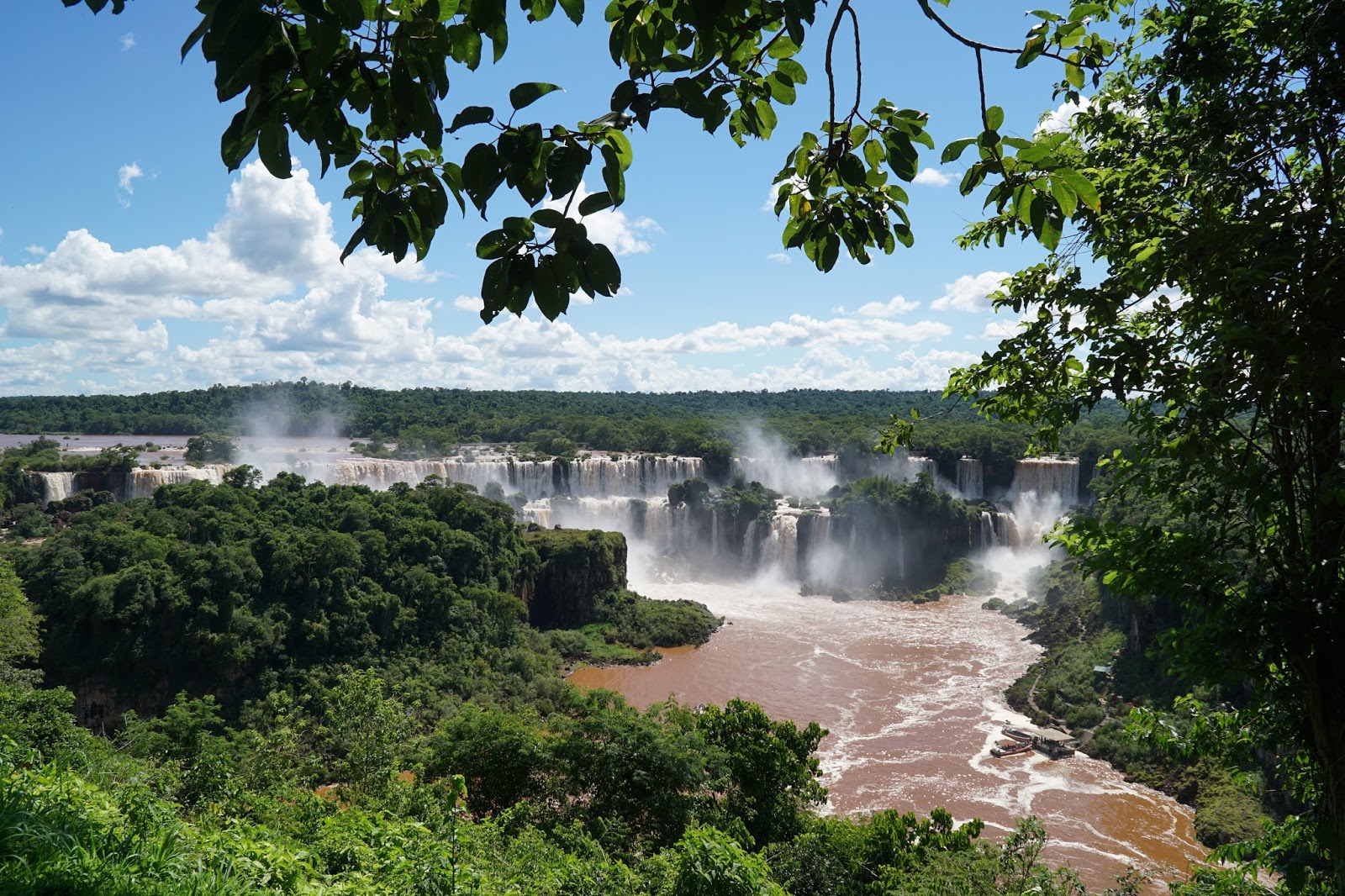
Looking across to Argentina from Brazil

Devil's Throat from the other side

So much water!

Before leaving the area we visited a bird sanctuary close the falls. Here they try to rehabilitate birds rescued from trafficking and hopefully release them again, but also provide a home to those unable to re-enter the wild. The highlights were walking through aviaries with Toucans and Macaws. They were such colourful and amazing birds and it was great to be able to get so close to them.

Toucan

One of many colourful macaws

Another long bus journey including a 6 hour wait in a bus station and some confusion owing to our lack of Portuguese language skills saw us arriving in Campo Grande, the gateway to The Pantanal. We had booked a 3 day tour of the huge wetland area over Christmas. We had decided that we needed to keep busy over the festive period as most places shut down and we would just miss home even more with nothing to do. We started our tour on Christmas Eve getting a lift with the owner of the company, Gil, and his wife to our lodge inside the Pantanal. We were staying in a room in a small chalet on huge stilts to ensure it stayed dry during the flood season, which was just starting when we were there. The Pantanal is the world's largest tropical wetland and floods every year with up to 80% of the area being covered with water. This means the wildlife congregates on the small islands left making it much easier to see them. At that point the whole area is only navigable by boat. That afternoon we went out on a boat trip to see what we could find. We saw howler monkeys, caiman, iguanas, storks, capybara, kingfishers, heron, toucans and many other species of birds. We also enjoyed a spectacular sunset before trying to spot jaguars with a huge flashlight, but with no luck.

Howler monkey

Christmas celebrations in Brazil are fairly small and limited to a big meal with family on Christmas Eve with presents exchanged at midnight. We joined in the meal with the owners and staff at the lodge, but it was very different to what we are used to. We spent Christmas morning canoeing down the river in search of more wildlife and enjoying drifting peacefully downstream. That afternoon we moved to another lodge on a farm further into the Pantanal and went horse-riding around their land. The horses were well behaved and followed each other in a line on the hour long walk sometimes wading through flooded areas up to their bellies. Despite initial panic at being atop a vehicle with a mind of it's own, Fiona even managed to enjoy it and made friends with her horse Shakira. The weather was very hot and humid so most activities took place early in the morning or around sunset with a much needed siesta in the middle of the day.

Fiona on Shakira

Other activities included a bush walk around the area, a jeep safari and piranha fishing. This involved wading into a lagoon up to our waists and fishing with a line and hook on a bamboo pole with raw beef as bait. Not only were the piranha swimming all around us (not a problem as these species wouldn't eat a human) but a couple of caiman were very interested in our bait and watched us with just their eyes above the water less than a few metres away. This was very unnerving but our guide assured us they didn't see us as dinner and wouldn't attack unless they felt threatened. If any got too close he proceeded to hit the water in front of them with his fishing pole to scare them off. The fishing was surprisingly easy and we caught several quickly, keeping the largest for our dinner and releasing the smaller ones.

Mmmm...dinner

Once back in Campo Grande on 27th December we caught up with family to find out about the Christmas celebrations we had missed back home. We were sad to have missed out on seeing everyone with the usual food and festivities, but we feel that it is a price worth paying for our amazing year of adventures. Christmas will happen again next year.

Ben's Christmas present

Our last overnight bus journey in South America took us to Rio de Janeiro where we celebrated New Year's Eve on Copacbana beach with 2 million other people. It is traditional to wear white to the party on the beach to symbolise a fresh start to the year, so we purchased 'Feliz Ano Novo 2017' t-shirts from a street vendor before heading to the beach. We had to buy special metro tickets in advance with a timed slot to avoid chaos on the underground system with so many people trying to arrive and leave at the same time.

Feliz Ano Novo

We arrived about 8pm, found a good spot in one of the less crowded areas of the beach and soaked up the atmosphere with a couple of beers. We watched as 4 huge cruise liners jostled for the best positioned to watch the fireworks from out in the bay. As we approached midnight the beach got more and more busy until by the time the fireworks started it was standing room only. Impressive for a beach that is over 4km long! The fireworks were launched from several barges moored out in the bay and lasted for 15minutes. Apparently the display is normally longer and bigger but due to the economic crisis in Brazil the budget had been massively cutback, but it was the still best display either of us had ever seen. After the fireworks we walked along the beach enjoying the various mini-parties taking place with different music and Samba dancing.

Amazing fireworks

Whilst in Rio de Janeiro we also went on a walking tour of the historic downtown learning about the history of the city and Brazil, and visited the Christ the Redeemer statue. The views of the city from the statue were amazing, but as it's one of the most popular attractions the huge crowds spoiled it somewhat. We found that the best view of the statue was from a distance where you can see it looking out over the city.

Jesus

Next we left the intense heat and humidity of the city and headed down the coast to the small colonial town of Paraty for a week. It was still hot, but the breeze from the sea kept us cool enough to sleep, which was difficult it Rio. The town is very picturesque with cobbled streets, white-washed buildings and many colourful boats moored along the river and seafront. At high tide the streets flood meaning you have to stay on the pavement or wade through the water. This is part of the original design and was to wash the sewage out of the street into the sea. We enjoyed a quiet week at the beach, sea kayaking around some small islands, trying stand-up paddle boarding and eating in a few nice restaurants. We took one day trip on a boat to explore some of the more distant islands of the coast of Paraty. The small beaches we visited were idyllic with palm trees coming down to the clean white sand, and the water almost as warm as a bath. The trip also included unlimited Caipirinhas (the local cocktail).

Pretty houses in Paraty

Look at the colour of the water!

After a week on the beach we travelled back to Rio de Janeiro to see a few more of the sights without the huge New Year's crowds before catching our flight out of South America. We had rented another apartment via Airbnb right in Copacabana a couple of blocks back from the beach. We spent one day walking around the lagoon where the Olympic rowing and canoeing races were held and visited the botanical gardens nearby. Unfortunately the gardens don't look like they have been cared for too well in recent years and it was a bit of a disappointment as they have the reputation as being amongst the best in the world. During a bike ride along the Copacabana and Ipanema beachfronts the skies opened and we got caught in the heaviest rain I have ever experienced. Within minutes we were completely drenched and there was so much water that the drains couldn't cope. The streets quickly flooded and we had to cycle and wade through several inches of water. Our last tourist activity was to catch the cable car up the large rock known as Sugarloaf. We went up at sunset so enjoyed views over the city and beaches in both daylight and the dark.

View from Sugarloaf

We couldn't leave Brazil without visiting a Rodizio restaurant, so we went on our last night as a farewell South America meal. This is essentially and 'all you can eat' meat buffet. After filling your plate with lots of tasty things from the unlimited salad bar, the waiters circulate around the tables with huge steaks, sausages, chickens etc on big spears, which they then carve small pieces off onto your plate. The meat was very good and we got very full. The following morning we headed to the airport to catch a 6hr flight back to Bogotá and then a 7hr flight to Los Angeles. Our South American adventure was over, but our Australasian one was about to begin.....


Sunday, 22 January 2017

Uruguay

After spending a couple of days in Puerto Natales resting and sharing our good news with friends and family, we flew back up north via Buenos Aires to Montevideo in Uruguay. Our first day in the Uruguayan capital was a Sunday which we spent wandering around the old city, watching locals fishing from the pier and enjoying a couple of beers in cafes.

Sunday fishing in Montevideo

In the evening we went to see some live Candombe music. This is a fusion of Latin and African drum beats owing to Montevideo's history as a slave port. Everyone in the local neighbourhood turned out to watch several acts on a small stage whilst enjoying a couple of street food stalls too. The evening culminated in over 100 drummers preceded by dancers and flag wavers, marching slowly through the streets to an ever changing drum beat.

Live Candombe music

On our second day in the city we hired some bikes and cycled along the seafront exploring a couple of beaches, the Montevideo sign (think Hollywood, but small and you can climb on it) and enjoying a great strawberry ice cream milkshake.

Fiona trying to blend in

We then headed further along the coast to the resort town of Punta del Este. 400,000 people descend on the town in the height of summer from all over Uruguay, Brazil and Argentina. However in mid-December the season hasn't quite started and it is a bit of a ghost town. This didn't bother us as we could enjoy the beach, marina and town without hordes of others.

Fancy yachts in Punta del Este marina

The weather was very windy one day, which stopped us from sitting on the beach, but we enjoyed watching huge waves crash against the sea wall and occasionally spray unsuspecting cars as they drove past. We stayed in a great Airbnb apartment for the same price as a hostel dorm bed! It was nice to have our own space for a bit and our host provided a tasty breakfast of fruits, yoghurts, cheese, meat and bread every morning.

Yum

The 'hand in the sand' on the beach at Punta del Este

Our third and final stop on our brief tour of Uruguay was Colonia del Sacremento. It is a small colonial port on the river opposite Buenos Aires with a rich history as it changed hands any times between the Spanish, Portuguese and British during the 16th and 17th centuries. There are a series of small museums which you can visit all of with the same ticket. They covered a range of topics from the history of the town and old maps of South America to natural history and blue decorative tiles. We spent a quiet morning pottering around them all before enjoying lunch in one of the street cafes watching the world go by.

Pretty street in Colonia

Inside the lighthouse looking towards Buenos Aires

Our time in Uruguay was short and fairly quiet, but we were happy to enjoy a more relaxed pace for a short while after so much hiking in the previous few weeks. After Colonia we headed north along the border with Argentina for 8hrs on one bus, crossed the border, waited 6hrs in a bus station then took a 12hr overnight bus to Puerto Iguazu, home of the famous falls.


Monday, 9 January 2017

Torres del Paine National Park

After spending ten days in Argentinian Patagonia we crossed the border back into Chile heading to the town of Puerto Natales. Here we prepared for our upcoming 5-day trek in the Torres del Paine National Park. The park is possibly the most famous national park on the continent and draws thousands of visitors from all over the world to gaze upon its natural wonders. We had planned to hike the W-trek, a route into the three main valleys in the park and the most popular route. We had booked our camping sites weeks in advance due to the popularity of the trek at this time of year. In Puerto Natales we met up with Susanne and Chris, fellow travellers we had first met in Ecuador, to hike together. We hired sleeping bags, a stove, cooking pot and a tent from the Erratic Rock Base Camp in the town. We had to practise putting up our tent in the plaza opposite the shop to prove we knew what we were doing. It was a small trekking tent and very light, just large enough for 2 of us to squeeze into with our bags. Food for the trip consisted of anything lightweight and that only need hot water for cooking. Porridge, rice, pasta, tortilla wraps, Nutella, tins of tuna, many cereals bars, salted peanuts and some chocolate. Chris decided to decant 2 bottles of wine into a plastic bottle for a treat on our first night! Emptying most of our belongings into a big sack to leave behind at the hostel, we carefully packed our backpacks with everything needed to survive 5 days. After a big last meal of cottage pie we were ready. It rained very heavily during the time we were preparing for the trek and we hoping it would stop so we didn't have to hike for 5 days in the rain!

Our food for 5 days

To get to the start point of the trek we first had to catch a bus to the national park entrance taking about 2 hours. Here we paid our entrance fee and watched a video about the rules of the park. Not having an open fire or cooking outside of designated areas was the most important. A fire started by a careless camper in 2011 burnt 40,000acres of the park, causing huge environmental damage. Next we hopped onto a catamaran to carry us across the lake to the starting point at Paine Grande. The water was an amazing turquoise colour and so clear as it was all glacier melt water.


Ready to begin

The starting point is at the bottom of the left hand stalk of the 'W' and our first day's walk was up to the top of that stalk before trekking the whole letter over the proceeding 4 days. We finally got going just before noon and hiked 11km over a rocky hillside to get to Glacier Grey.  Unfortunately most of the trees that used to cover the hillside here are burnt black and have not began to grow back following the fire, so it looks quite barren and lifeless. It took a while to get used to hiking with a heavy pack on, but after much adjusting of straps we got into our stride.Fiona and I had purchased trekking poles (we found them really useful on the Inca Trail) and they certainly made climbing and descending a bit easier. After putting up our tents we walked down to the edge of the lake to see the glacier itself.

Glacier Grey

On the second morning we left our bags at the campsite and hiked an hour further along the trail to see the glacier from above. The terrain here was very different from the day before as we walked through a thick forest of birch trees and moss covered rocks. There were also a couple of hanging rope bridges crossing ravines. Back at the campsite we had our lunch then did the opposite hike of day one back to Paine Grande campsite. This campsite was really good and included an indoor area for cooking and eating, which had amazing views of the peaks and lake at sunset. By this point we had heard from the park rangers that one of the rope bridges we were to cross the next day and been taken out of service due to being hit by a falling tree. This meant completing the 'W' via the usual route was now impossible, but we still had reservations for a campsite not far past the damaged bridge. We would have to come up with a new plan.

Paine Grande campsite

We caught the catamaran back across the lake, then a bus to the park entrance, then another shuttle bus to the other side of the 'W' on the third morning. This was time consuming and frustrating as we really wanted to be walking again. We would now be hiking an 'I' and a 'V' that weren't joined together.

View from the catamaran

Eventually we started walking at 3pm and walked for 6hrs to our campsite. It was a really hot afternoon and we frequently stopped at mountain streams to fill up our water bottles. The scenery was very different on this side from the first two days. We started walking through open meadows, then low bushes and eventually even along a pebble beach by the lake. This lake didn't have a glacier at it's source so was a beautiful deep blue colour rather than the turquoise of the glacier lakes. Our campsite for the third night was on a tree covered hillside above the lake. Due to lack of flat ground for tents, small wooden platforms had been erected amongst the trees, so we camped on them.

Hiking 6hrs with a heavy back pack is not enough of a challenge for Chris

Our hike started early on the fourth day as we had a long way to go. We hiked back along the way we had come the afternoon before, before turning off to head up towards the famous towers from where the park gets its name. It was very hot again and we made several stops to rest and cool down in the shade. Chris decided the scenery looked like it was from Lord Of The Rings and spent significant parts of the walk humming the theme tune! We also used the hike to learn some Norwegian, with Chris supplying us with 'Norwegian Word of the Day'. After arriving at our campsite in the late afternoon, we had a dinner of pasta before hiking up the last 1hrs steep climb to look out over the lake and towers at sunset. The view was incredible; the towers rose as huge pillars of rock from the lake which was glistening in the fading light. Looking over this amazing view I proposed to Fiona. Fortunately she said 'yes'!!!! We are both happy and very excited.

Las Torres Mirador

On the final day, we hiked back down to Las Torres hotel before lunch to catch our bus back to Puerto Natales. Back in town we went out for a meal of steak, grilled lamb and red wine to celebrate. Torres del Paine has a reputation for going through all seasons of weather in one day so we had packed accordingly. However we had been very lucky, experiencing only a light drizzle on the second day and mostly hiking in glorious sunshine. The whole trek was an amazing experience and one that we will never forget. We were very fortunate to be able to share it with Chris and Susanne who made it even more fun.


Thursday, 5 January 2017

Argentina

Crossing the border from Chile into Argentina involved a spectacular bus ride over the Andes. The road climbed very steeply in a dozens of switchbacks until we were passing ski resorts and the last remnants of snow from last winter. The border post itself is at almost the highest point of the pass and is inside a giant shed to protect it from the winter elements. It was also the slowest border crossing we had experienced so far. Descending into Argentina we headed for the city of Mendoza and got a brief glimpse of Aconcagua, the tallest mountain in the Americas.

Mendoza is the centre of a huge wine growing region and we spent our 4 days in the city making the most of this. We spent 3hrs one afternoon having a 7 course meal with paired wines at the Casarena vineyard in Lujan. Whilst expensive for our travellers budget, we paid a fraction of the price that such a meal would cost back in Europe. Both food and wine were fantastic, along with the views across vineyards and onto the snowcapped mountains. The pastrami with chickpea puree and the fillet steak were particular highlights of the meal. A great way to visit as many vineyards as possible is to hire bikes and cycle between them. We visited 4 different vineyards experiencing a small family run business and a huge commercial operation with a couple in between. The Malbec wines (for which the region is internationally famous) were amazing, but Merlot and sparkling wines were also very good. The highlight of the day was tasting some wine straight from the barrel at a tiny organic wine producers late in the afternoon. That evening our hostel put on an asado (Argentinian BBQ) with more meat than we could handle.

Good wine and food in Mendoza


Next up we headed to the city of Cordoba for a few days. We enjoyed a couple of walking tours, reading our books in the huge park and tasting the local delicacy of Choripan. This is a hotdog with a chorizo sausage and endless toppings of onions, pickles, tomatoes and various things I can't name! Cordoba would be a great city to be a student (several of the nations top universities are here) or live, but we found little to occupy the tourist for more than a day. There are many great bars, restaurants, cafes and live music venues in which to while away the days, but on a travellers budget we couldn't afford to do this too often. Whilst in Cordoba we also experienced our first major problem with a hostel. Unfortunately on consecutive days the local authorities decided to switch off first the water and then the gas supply to the entire street. Understandably this made washing and cooking very difficult.

Making a new friend


Our next stop was the capital of Buenos Aires. In contrast, our hostel here was very good and had a great breakfast included. At this point it seems sensible to mention Fiona's new favourite food, Dulce de Leche. This is a very sweet caramel concoction of condensed milk and sugar that the Argentinians seem to put on everything. Ben was sceptical at first, finding it too sweet, but came to appreciate a dollop of dulce in the morning's porridge. We had a great time in Buenos Aires and would happily return as there are so many things we didn't do. Our first day was spent on a walking tour of part of the centre and the district of Recoleta. Spending even a short time in this neighbourhood it is clear why the city was known as the Paris of the South. The nobility spent much of the late 19th Century building bigger and bigger homes, churches and palaces in various European styles to compete with each other and show off. There are several boulevards that could easily be dropped into Paris and no-one would notice. Interestingly Argentina was the 5th richest nation in the world at the end of the 19th Century and the future looked bright. However the country has little natural resources and had no manufacturing industry at the time, instead relying on cheap agricultural exports to afford to import anything it needed. After the crash of 1929 the world stopped buying Argentina's goods and the economy has struggled along ever since.

Walking around Buenos Aires

One of the bizarre highlights of the city is a visit to the Recoleta cemetery. This is where the rich and famous of Argentina were buried (and in some few cases still are). It is a city within a city, where each mausoleum has an address and the streets names. Even in death the founding fathers of the nation were determined to show they were better than their neighbours by building bigger and grander tombs. Eva Peron is buried here in her families tomb and her grave is the most visited often with a queue along the street. We also learned about a young girl who urban legend has it was buried alive after suffering 'catalepsy'. A graveyard worker noticed her coffin had moved one day and suspecting robbery opened it to find deep scratches on the inside of the lid and bruises on her hands. Our guide told us that the phrase 'saved by the bell' has it's origins from people who were scared of being buried when not actually dead having bells installed in their coffins so upon waking up they could ring the bell and be rescued. Although it makes a good story and such things did happen we are not sure that is actually where the phrase comes from.

One of the streets in Recoleta cemetery


We also visited the colourful streets of Boca, a neighbourhood surrounding the cities docks and home of the famous Boca Juniors football club. Neither of us are big football fans, but football is such an integral part of the culture here that we couldn't resist visiting the giant Bombanero stadium. Whilst in the city Argentina played Colombia in a qualifying match for the next world cup and a significant portion of the city wore there national shirt with the name of Lionel Messi on the back that day. Finally we couldn't leave Buenos Aires without experiencing Tango. We had a short lesson, followed by dinner and then a Tango show at one of the many venues in the city. Although aimed entirely at tourists and a bit cheesy, we had a lot of fun and saw some very impressive dancing.

Outside La Bombonera

Colourful streets of Boca


Leaving Buenos Aires we took our first flight since landing in Bogotá, having travelled entirely by land across the continent until now. We flew down to the town of El Calafate in Patagonia. We would spend about 3 weeks in Patagonia between Argentina and Chile and it was high on the list of places we were looking forward to most. We spent a few days in El Calafate itself visiting an interesting museum about the science of and history of exploration of glaciers and enjoying the Patagonian delicacy of grilled lamb. The main reason for visiting the town, however, was to do a day trip to the Perito Moreno glacier nearby. The scenery on the bus trip there was stunning; grass steppes gave way to evergreen forests and snowcapped mountains and finally to our first glimpse of the glacier itself. Neither of us had ever seen anything like it before, it was amazing. Most glaciers in the world move up to several meters per year, some are almost static, but this one moves up to 2m per day! The noise as it moved along was incredible. Loud creaks and groans followed by a roar like thunder or a huge explosion as huge chunks fell off into the lake. Two hours quickly passed as we walked along the paths on the peninsula nearest the glacier, hardly daring to take our eyes off it lest we miss a 'calving'. This is the term used to describe when a giant chunk of ice breaks free from the glacier. The glacier metaphorically gives birth to an iceberg. Fortunately we did see such an event and it was spectacular.

Perito Moreno Glacier


Next up we headed down to the shore to catch a boat across to the glacier itself. We put on some crampons and followed our guide out onto the ice. We spent an hour and a half going up and down slopes, gazing into clear blue pools and even tasting some glacier water. Again we have run out of superlatives to describe the experience. Needless to say, we had fun and enjoyed ourselves.

Ice, ice, baby....

Looking cool...


Leaving El Calafate we headed north to the small town of El Chaltén to spend a week hiking. The town has a permanent population of just a few hundred but this swells in late spring to a few thousand as it is one of the continents top hiking destinations. There are some multi-day treks and world class rock climbing in the area, but we stuck to day hikes. We enjoyed 3 long day hikes to the base of Mount Fitzroy, Laguna Torre and Loma del Peligue Tumbado. The first of these included a very steep climb up the last kilometre to enjoy a view of the huge towers of rock rising from the lake. The hike to Laguna Torre culminated in another glacier and a view (obscured by cloud) of another famous peak, Cerro Torre. The final of these 3 walks was to a viewpoint overlooking both of the valleys visited in the previous treks and gave great views of the whole area. We were also lucky enough to spot a few condors on this day. The rest of our time in El Chalten was spent relaxing on the days between the big hikes or doing shorter hikes to waterfalls or other viewpoints. The week acted as great preparation for the 5 day trek in Chile we were to begin a few days later......

Mount Fitzroy


Thursday, 15 December 2016

Chile

The border post to leave Bolivia is basically a shed in the middle of the desert. After queueing for our stamp we caught a bus down from the altiplano to the Atacama desert and the town of San Pedro de Atacama. At this point we were in no-man's land as we didn't cross the official entry point to Chile until the town. San Pedro is small outpost in the middle of the driest desert on the planet and has swollen in size in recent years due to increasing numbers of tourists. Despite this it retains a pleasant and inviting feel. After 4 busy weeks travelling huge distances and doing many activities we decided to slow down for a couple of weeks in Chile. We spent a couple of days relaxing in San Pedro with a short afternoon trip to Valle de la Luna and a spectacular evening stargazing. Due to the high altitude and lack of humidity in the Atacama desert the conditions for viewing the night sky are arguably the best on the planet. Indeed NASA and several other space organisations have observatories in the area. We spent an hour having a talk about the night sky and what we could see with the naked eye before looking through 10 different high powered telescopes trained on different objects. We saw Mars, the Orion nebula, the Andromeda galaxy and a 'supercluster' of 300 million stars amongst other things.

Valle de la Luna

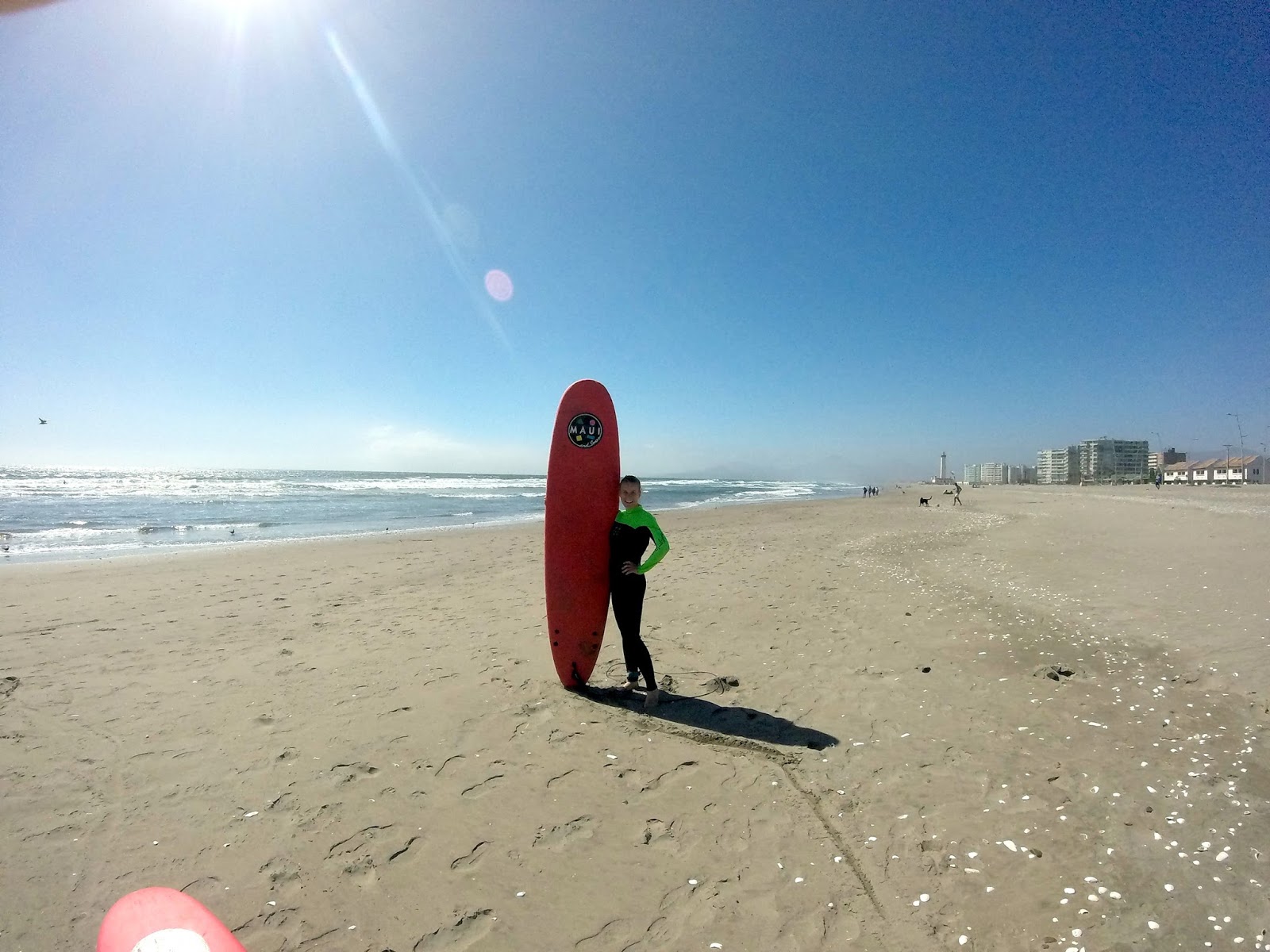
Leaving the desert behind we finally returned to sea level for the first time in a month. We spent 4 relaxing days in La Serena on the Chilean coast making friends with an English girl called Katy and a German couple called Samira and Seb. Together the 5 of us surfed, ate and had a lot of fun doing not very much at all. We also discovered a shop selling very tasty custard doughnuts! Sometimes the joy of travelling is not seeing amazing sights, but making new friends and talking about our different views about, and experiences of, the world.

Fiona ready to surf

After a short stop in the town of Vicuña where we visited a Pisco distillery we headed south again to arrive at the port city of Valparaiso. The city became very wealthy and expanded rapidly in the 19th century as it was a major stop off point for ships from Europe on their way to California. Evidence of various European styles are evident in the older parts of the city and the grand buildings around the main plaza. Once the Panama Canal opened in the early 20th century growth stagnated and the city has never regained its former glory. We spent an interesting morning on another walking tour; in particular learning about the Pinochet dictatorship of the 1970's and 80's. It is still a controversial topic in Chile as many are still fans of the regime due to the economic prosperity and stability that it provided despite the evidence of terrible human rights abuses that took place (more on this later). 

Street art by Un Color Distinto

Our friend Katy from La Serena caught up with us again in Valparaiso and we spent a fun day together wandering around the hill above the port. Here the buildings are laid out in a rather chaotic fashion with tiny alleyways and many staircases linking streets. There are a number of old funicular railways providing easy access back down to the port. The area has many great cafes, bars, restaurants and artisans stalls, but the highlight for us was the street art. Almost every available vertical surface is covered in amazing, brightly coloured art. We went on a guided tour and began to recognise the styles of different artists and even got to meet a few of the artists themselves. 

Our last stop (for now) in Chile was the capital of Santiago. The city has developed into a great capital with European standard amenities (including a fantastic metro system and world class universities) that made it feel more comfortable to us than say La Paz, but hasn't lost the relaxed South American feel we have got used to. Being only a couple of hours from both the beach and mountains is a great bonus in my eyes too! The hostel we stayed in offered free ice cream and movie nights and a BBQ night which was a great way to meet fellow travellers. Highlights of the city included a great crab stew eaten in the fish market, cycling along the large number of traffic free cycle lanes by the river and a ride in a funicular up the Cerro San Cristobel (a big hill) from where we enjoyed the view across the city. We also survived an earthquake measuring 6.1 on the Richter scale without even realising it had happened! It turns out there is at least one earthquake a day on average in somewhere Chile so buildings are constructed accordingly and the Chileans don't really get fussed until it is a 'big one'. Interestingly the earthquake that caused so much devastation in Italy in August this year also measured 6.1.

A view of Santiago looking towards the Andes


We spent a moving few hours one morning visiting the Museum of Memories and Human Rights. This serves both as a memorial to those who simply disappeared during the Pinochet regime and education to everyone to ensure that it never happens again. From the military coup in 1973 until Pinochet stepped down in 1990 ten of thousands of people were arrested, held without trial and tortured. Many were executed and some just disappeared never to be seen again. The exhibitions are quite graphic at times, but necessarily so in order to convey the truth of what happened. Despite many attempts, Pinochet was never brought to justice and died a free man.

The Museum of Memories and Human Rights


We will return to Chile later in the far south of Patagonia, but for now it is on to Argentina.


Monday, 14 November 2016

Bolivia

The title of this blog isn't quite correct. We'll talk about the last two days in Peru first! The Inca Trail was very physically demanding, so no-one felt like too much strenuous activity for a couple of days afterwards. The trek had also made Fiona's cough worse so she spent the next two days in bed or on the sofa in the hostel recovering. The rest of us made a few short trips out to see other Inca ruins nearby and we all went out for a celebratory dinner with some of our new friends from the trek. We took the opportunity to try an alpaca steak, which was very tasty.

We left Cusco on a night bus and headed to the town of Puno on the edge of Lake Titicaca. We spent just a few hours there in the morning to visit the floating islands before crossing the border into Bolivia. The floating islands are constructed from large blocks of mud and reed roots, which are then tied together with rope and layers of cut reeds laid on top. These islands are surprisingly stable and the largest of which is big enough to build several reed houses on. The short tour to visit them by boat was interesting but a bit touristic and the interaction with the people who lived there a bit contrived.

After getting back on the bus and crossing the border into Bolivia, we arrived at the town of Copacabana (very different from the famous area of Rio de Janeiro with the same name). We (Fiona and Ben) had spent 25 days in Peru, which was the longest either of us has ever spent continuously in one country outside the UK. We were a bit sad to leave, but left with memories of great adventures and were excited about Bolivia. 

There isn't much to do in Copacabana, but it is the place to catch a boat to Isla del Sol in the middle of Lake Titicaca. Lake Titicaca is a huge 160km long by 65km wide expanse of water that forms part of the border between Peru and Bolivia. It is also the highest navigable lake in the world at 3600m above sea level. It was odd to see so much water that it felt like a small sea, but in fact we were really high in the mountains. We spent the hour boat crossing bracing against the wind sitting on the roof of the boat. It was very exhilarating, if a little cold. Isla del Sol is quite small and it is easily possible to walk the length of it in one day. Unfortunately we had only 24hrs on the island so didn't have time walk there and back in a day. Instead we went for a short walk to see some of the island and enjoyed a great lunch overlooking the lake and back towards mainland Bolivia. We are finding that a considerable amount of time on this trip is just spent enjoying the view. We all felt we could have spent a couple more nights on the island exploring fully.

Isla del Sol on Lake Titicaca

Our final experience of the lake involved watching our bus being put on a concrete raft and floated across the narrowest part of the lake (less than 1km). We weren't allowed to stay on the bus and crossed in a small motor boat. Once safely on the other side we hopped back on and drove to the city of La Paz. At this point we realised that the infrastructure in Bolivia is not quite up to the standards of the countries we had visited so far. The main road from the border with Peru towards La Paz just seems to stop an hour short of the city. There used to be one, but they are currently in the process of digging it up to build a new highway. Unfortunately they have dug the whole thing up before starting on any of the new road so the journey was very bumpy and the views consisted of huge piles of rubble for many kilometres. 

Gawaine and Ben got up early on the first morning in La Paz to cycle down the North Yungas Road a.k.a The World's Most Dangerous Road, a.k.a Death Road. The Rowe sisters decided they had more important things to do and didn't join in. Until 2007 over 200 people died each year navigating the single track gravel road on the edge of a cliff. This was mainly due to it being used for two way traffic including trucks and buses. It is not hard to imagine how a truck or bus filled with passengers plunges over the edge when trying to pass another on a road barely wide enough for one. Thankfully a new tarmac tow lane highway was opened with large vehicles now banned from using the old road. That said 15 people have still died this year. These deaths are due to a combination of stupid overtaking manoeuvres on around blind bends on the tarmac part of the road at the top and cyclists trying to take selfies and not looking where they are going. There are several monuments to those who have died along the route.

Ready for action

Having been kitted out with appropriate clothing (circa 1990), knee and elbow pads, full face helmet and a bike with good brakes we began the ride on a tarmac road high above La Paz. This gave us time to get used to our new bikes and appreciate the dramatic scenery. Although we took care to keep our eyes on the road and not get distracted by the view. An hour later the tarmac ran out and we diverted onto Death Road proper. After a slow start we gained confidence on the terrain and picked up some speed. The ride along the the gravel track was exciting and required concentration, but the ever present cliff edge and the scenery as we descended from mountain pass to jungle track made it even more exhilarating. 50km later we arrived at the bottom. We had survived the World's Most Dangerous Road!

That's a big drop!


Braving the edge

Meanwhile Fiona, Hannah & Rachel visited the Valley of the Moon and the Witches Market where amongst many interesting items you can buy a dried llama foetus. It is traditional before constructing a new building in Bolivia to hold a small ceremony with a shaman and provide an offering to Pachamama (Mother Earth). In the case of a house or similar sized building a llama foetus is deemed a sufficient offering. Urban legend has it that for large buildings a human sacrifice is necessary. There are several tales and even a film about homeless people being plied with alcohol, invited to a party and then buried alive in the foundations of buildings. Hopefully this is just a story made up to entertain the tourists.

Leaving La Paz on yet another night bus we headed to Uyuni to begin our adventure on the famous salt flats. We had booked a 3 day tour of the Salar de Uyuni and nearby national parks. This would be our last few days as a group of 5 before Hannah, Rachel & Gawaine's holiday was over and they headed back home. The tour began with a visit to the train graveyard just outside town. Uyuni was founded as a rail hub for distribution of minerals from mines in the surrounding areas out to the Pacific coast. As Bolivia no longer has a coastline (Chile took the land in the Pacific Wars of the late 19th century) and depletion of mineral reserves, the trains were largely abandoned in the mid 20th century.

Uyuni train graveyard

We then headed out onto the largest salt flat in the world, the Salar de Uyuni, the bed of a huge prehistoric lake. It is a pretty odd landscape and it felt strange to be able to see the horizon in every direction with a featureless terrain in between. The salt has cracked into huge polygonal slabs and if you dig in the cracks between them you quickly find brine. It also makes for some great forced perspective photos!

Yorkshire, Yorkshire!

Jump!

Ouch!

Giant llama.....run!

We stopped off in the very middle of the salar to visit the Incahuasi island. This is a bizarre cactus covered rock that rises up out of the vast emptiness of white. Some of the cacti are hundreds of years old and can reach 10m in height.

Incahuasi

Sunset on the Salar de Uyuni

The first night was spent in a hostel literally made of salt on the edge of the salar. The walls, tables, chairs and even beds were all made from breeze block sized slabs of salt. As impressive as the salt flats were it was the rest of the trip that really took our breath away. We had naively just expected more of the same, but every 30minutes it seemed like we had arrived on a different planet as we drove along. There was sandy desert, green plains with llamas on, rocky scrub land, huge volcanoes, mountains, lots of flamingoes on a series of huge lagoons and finally fumaroles and boiling mud. The photos here give you a taste, but they can't really do justice to the incredible scenery we saw.

One of the many lagoons in the Siloli desert

Sunny but very cold

Flamingoes on Laguna Rojo

Fumaroles and boiling mud pots

We spent the second night of the tour, and the final one as group of 5, in a basic lodge near the Chilean border. We would say goodbye the following morning as we (Fiona and Ben) were dropped at the border post whilst the others returned to Uyuni then La Paz to fly home. After dinner that night we sat in the dark in natural hot springs enjoying the night sky. Without any light pollution and being at over 4000m there were so many stars to see. It was a memorable way to end our 3 week adventure with Hannah, Gawaine and Rachel, and our time in Bolivia.