Monday, 22 May 2017

New Zealand Part III - More South Island

The day after dropping off the camper we picked up our new wheels from the airport. We had booked the cheapest car available and were surprised to find a brand new car with just 29km on the clock - no pressure on keeping it in pristine condition then! It was very comfortable and would serve us well for the rest of our time in New Zealand. Our first stop was the town of Oamaru where we stayed in our first hostel for a month. Shared kitchen, bathrooms and bunkbeds were back! The town has a quirky steampunk museum, a street of old warehouses converted into independent shops (including a great adventure bookshop with a replica of Shackleton's boat the James Caird!), but the highlight of the town is the Little Blue Penguin colony. At sunset we sat on the edge of the shore and watched as 143 penguins came ashore after a days fishing and returned to their nests.

Little Blue Penguins

Heading further south we visited the Moeraki Boulders, which are an unusual series of perfectly hemispherical rocks strewn across the beach. For those Star Wars fans out there, one looked just like the Death Star had crashed into the sand. Later that day we arrived in the university town of Dunedin and spent the evening at rugby game. The local team, The Highlanders, were playing The Crusaders from nearby Christchurch. It was the closest thing to a local derby and it made for a great atmosphere. A large portion of the settlers that founded the modern town of Dunedin were from Scotland, hence the team name, and they are proud of their heritage. The team were led out onto the pitch by a full pipe band in tartan. Despite leading 27-6 the Highlanders managed to concede 3 tries in the last 15minutes and lose the match in the dying moments of the game. An exciting game to watch even for non-rugby fans! Whilst in the town we visited the very interesting Otago Settlers Museum charting the history of the town and providing an insight into the reasons that people gave up their lives in the UK and set off to the other side of the world. The museum included a fascinating exhibit on the 'Dunedin Study', a 40 year longitudinal study into health and development, following the same 1000 children from birth in the early 1970's to present.

The Moeraki Boulders

Highlanders vs Crusaders

Before leaving home last August we had booked huts on one of the most popular Great Walks in New Zealand. The Milford Track, the most popular, had already sold out 8 months in advance, so we had booked the circular Kepler Track instead. This is a 63km route from Te Anau and includes a sample of most of the terrain to be found in Fiordland. The first day starts with a flat walk along the edge of Lake Te Anau before heading steeply uphill through the bush at Brod Bay. It was hard work in the heat with a heavy pack, but we were treated to amazing views across the lake once we'd cleared the tree line and reached the first hut. The following morning we awoke to find ourselves above the cloud that had settled over the lake during the night. Most of the walk that day was along the ridge line, including a small detour to the top of Mount Luxmore, again with incredible views all day.

Not a bad view to wake up to

Along the ridge from Luxmore towards Iris Burn

The final hour was a steep rocky descent through the bush to the second hut at Iris Burn. Here we were advised to hang our boots up from pegs rather than leaving them outside for the night as the local cheeky Kea (mountain parrots) had a habit of stealing boots and pecking holes in them. The third day was an easy 4hr walk through the beech forest to the edge of Lake Manapouri at the Motorau Hut. Here we were treated to an incredible sunset and had fun talking to the other hikers. The final day was a 16km walk along the flat through the beech forests back to where we started. We finished about lunch time and headed back into Te Anau for another tasty pie from the same shop as on our last visit a month before. 

Kea

 Sunset over Lake Manapouri

We finished the trek just in time, as we woke up the next morning and the beautiful sunshine had given way to greyness and showers. We packed up all of our stuff and headed off along the 'Southern Scenic Route'. We stopped at several coves and beaches along the way (although never for too long given the weather) until we reached the town of Invercargill. The visitors centre gave us more than just useful local information as they had some resident Tuatauras which we visited. These pre-historic creatures look very lizard like but are actually closer relatives of dinosaurs. They live to over 100 years old! We only stayed one night here - giving us enough time to see the town's ornate water tower and the nearby small town of Bluff - before continuing east along the coast. 

We spent the next few days exploring the Catlins, the south east corner of the South Island, known for it's rugged natural beauty and wildlife. It is a little bit off the main tourist route meaning that it's a bit quieter, and there are far fewer paved roads (turning our lovely blue car a rather dusty sandy colour). Staying on a farm during sheep shearing season meant we were woken up at 7am by loud music when a car full of local young people showed up to work their way through the fields of sheep. The highlights of these few days were visiting the most southerly point of mainland New Zealand (closer to the south pole than the equator) and seeing a pod of dolphins playing in the shallows of the shore at Porpoise bay. 

Nugget Point Lighthouse in the Catlins

Leaving the Catlins we spent a night in Milton - there's nothing really to see in the town, but it was a convenient stop over. The owner of the hostel was an eccentric guy whose first question on our arrival was what our Chinese zodiac sign was and he spent part of the evening trying to teach us to juggle. We then crossed Otago and spent a couple of days staying in Alexandra from where we cycled a section of the Otago Central Rail Trail. This cuts through some stunning scenery and partly due to the old railway equipment had the feel of the Wild West gold rush areas. As a disused railway there aren't any steep hills, but in order to cross the one big hill it does go uphill continuously for 20km. This made for a very easy and speedy return to town after lunch at the half way point.

At the start of the Otago Central Rail Trail

Our friend Jake had flown out to New Zealand for a 3 week holiday and we met up with him for a few days in and around Queenstown. Our first day clashed with a huge Harley Davidson rally in the town. Whilst it was fun to wander along the rows of parked bikes it did mean accommodation in the town was hard to come by and we stayed in nearby Arrowtown again for one night. We did a hike up the imaginatively named 'Big Hill' overlooking Arrowtown, which involved crossing a stream several times by taking off our boots and wading through. Jake took this opportunity to go for a 'swim' in the freezing cold water that turned into a 5 second dip before trying to warm himself up again. In Queenstown itself we took the gondola cable car to the top of the mountain above the town and spent an afternoon on the luge. This involves riding a sledge crossed with a go-kart down a paved race track down a short section of the mountain as fast as possible. Fiona decided not to get involved with the closely fought duels between Ben and Jake. We also queued for an hour to try the famous Fergburger. It is a very tasty burger and maybe ten years ago when launched it was pretty special, but when gourmet burger joints are now commonplace it doesn't have the same wow-factor we expected. We left Jake to explore Fiordland on his own (we'd meet up with him again on the North Island) and made our way once again through Haast Pass and up the west coast.

Mmmm... burger

We drove the 800km from Queenstown to Blenheim in two long days driving. Having already driven up the west coast once we were keen just to get the driving done and begin exploring the last part of the South Island. We stayed a few days in Blenheim in the Malborough wine region enjoying some of the best wines New Zealand has to offer and visiting the brilliant Omaka Heritage Aviation Centre. This contains a large collection of WWI and WWII fighter planes displayed in exciting dioramas created by Weta Workshops (more on them when we get to Wellington). A significant number of the planes belong to director Peter Jackson of Lord Of The Rings fame. The museum included a fascinating exhibit on the war in Russia in WWII, something which is often only briefly mentioned in a British history education.

German WWI fighter plane

Finally we headed to Picton to catch our ferry through the Queen Charlotte Sounds and across the Cook Strait to the North Island.

Ferry through the Queen Charlotte Sounds


Tuesday, 2 May 2017

New Zealand Part II - The Campervan

Our campervan was a 6 berth model based on a VW sprinter van chassis from the appropriately named hire company Britz. We had the bed above the cab while Sally and Ian had the bed at the back of the van. The spare 2 berths meant that we didn't need to turn the dining area into a bed every night and back to a table again for breakfast. It would have been a cosy fit for 6 adults and we were glad of the extra space. Ian drove the first leg out of Christchurch and across the Canterbury plains to the south. The plains were very dry and all the vegetation was much browner that we had expected. Huge sprinklers were in place in every field to ensure the crops got enough water and the grass was green enough for all the sheep. It turns out that the Southern Alps running along the spine of the South Island cause huge amounts of rain to fall on the west coast leaving the east coast in a rain shadow. Droughts and wildfires are not uncommon.

Ready for our road trip!

That afternoon Ben drove us past the stunningly blue Lake Tekapo and Lake Pukaki to arrive at our first campsite in Mount Cook National Park. The site was over 50km from the nearest town and we were surrounded by views of the Southern Alps and of course Mount Cook itself. We stayed for 3 nights doing hikes up countless steep steps to Sealy Tarns and along Hooker Valley past several glaciers. Over the course of our 3 weeks in the campervan we would mostly stay at campsites in scenic locations run by the Department of Conservation (aka the DOC). We were very impressed by the facilities (often basic, but clean and functional) at each site and the locations themselves. The DOC manages all of the National Parks in the country including the tracks and visitor centres in each. The tracks were always very well marked and we found plenty of interesting information on boards at the start of each major walk. The visitor centre in Mount Cook National Park was particularly interesting with exhibits on local flora and fauna, Maori history, a history of climbing in the region, glaciology, geology and mountain rescue.

Lake Tekapo with Mt Cook

Sealy Tarns and Hooker Glacier

After a great start to our outdoor adventures in New Zealand, we eagerly headed further south through Queenstown and Glenorchy to the start of the Routeburn Track. Queenstown is the famed adrenalin sports capital of New Zealand, and although we did spend time their later, we just drove through on this occasion. The Routeburn Track is one of nine 'Great Walks' in New Zealand, which means it is particularly popular and advance bookings are required to stay in one of the huts along the way. It is 32km long and crosses the Southern Alps via the Harris Saddle. It is normally hiked in 2 or 3 days taking in all the scenery along the way, although it can be done in an ambitious one day hike for the fit and healthy. As keen we were to give this a go, to drive between the two ends is a 300km journey, meaning we'd be a long way from our van at the end of the day. Instead we hiked in from the Routeburn falls end up to the highest point at the Harris Saddle and back down the way we came. The lower slopes are covered in amazing native forest consisting of beech trees, ferns and more moss than we had ever seen. Everything was green and covered in moss. Once above the tree line it started to rain and then hail, but we carried on enjoying the challenge and views, safe in the knowledge we had a cosy dry campervan to go back to at the end of the day. Had it been a small 2 person tent, I'm not sure we would have been so enthusiastic!
Sally & Ian at the start of the walk

On the way back from the top. (Orange dots are people)

One of the highlights of the South Island was our trip to Doubtful Sound. Despite the name 'sound' it is actually a Fjord (a long, narrow, deep inlet of the sea created by glacial erosion) and originally charted by Captain Cook as 'Doubtful Harbour' as he was doubtful he could navigate back out under sail if he were to sail the Endeavour into it. In Maori its name is Patea - 'The sound of silence'. Regardless of its name it is very remote and getting to it requires some effort. After a 1hr boat trip across Lake Manapouri followed by a 20km drive over Wilmot Pass we made it to the edge of the sound to embark on our 3hr cruise. Incidentally, Wilmot Pass is famed as being the most expensive road in New Zealand, having been built solely for the reason of getting construction equipment in to build the hydroelectric power station on the west arm of Lake Manapouri. Words and photos don't really do justice to the magnificence of Doubtful Sound. It is a huge expanse of water trapped between steep cliffs rising hundreds of metres above the water. The rainy, overcast day on which we experienced the sound only added to the atmosphere and created countless temporary waterfalls on the cliffs. 

Spectacular Doubtful Sound

The next couple of days were spent eating a tasty venison pie in Te Anau, driving along the scenic Milford Road and a day hike up to Key Summit and Earland Falls - at the other end of the Routeburn Track to the walk we had previously done. We continued along the road, stopping at various points of interest along the way, finally arriving in Milford Sound itself in the late afternoon. All the day trippers from Queenstown and Te Anau were leaving, and the only accommodation was a small campsite so it felt like we had the whole place to ourselves for the evening. The following morning we took a cruise out on Milford Sound under clear blue skies. Famously Milford Sound is one of the wettest places in New Zealand receiving over 7000mm of rain a year (more than 10 times that of London). It was great to be able to see it under such fair conditions and provided a different experience to Doubtful Sound. The highlight was to see a large pod of dolphins swimming towards and then right underneath our boat.

The view from Key Summit

Milford Sound

After a brief stop in the picturesque Arrowtown where we learnt a bit about the New Zealand's 19th century gold rush, we headed for the west coast. We drove via the Haast Pass which was only opened in 1965 to provide a link from the west coast to the south. It is a long, twisty road through lush beech forest and along steep mountain sides. A very small car park for a waterfall along the road provided an interesting parking challenge for a large camper van. Careful manoeuvring with the other 3 passengers outside watching each corner was required resulting in more time being spent parking and un-parking than actually looking at the waterfall. Once on the coast we visited the dunes, dune lakes and swamps of Ship Creek before spending the night next to the beautiful Lake Paringa. There was so much driftwood washed up on the beaches that it formed natural abstract sculptures along the high tide mark.

The west coast is famous for its rain and unfortunately it arrived just as we reach Franz Josef Glacier. The glacier has retreated rapidly in recent years resulting in difficulty getting to the face of it as it is so unstable. On the day we were there the visibility was pretty poor and we could only just make it out through the rain and mist. We spent the rest of the day sheltering in the camper playing scrabble (Fiona claims her victory was her first ever) and sitting in the hot pools opposite our campsite. 

The beach at Ship Creek

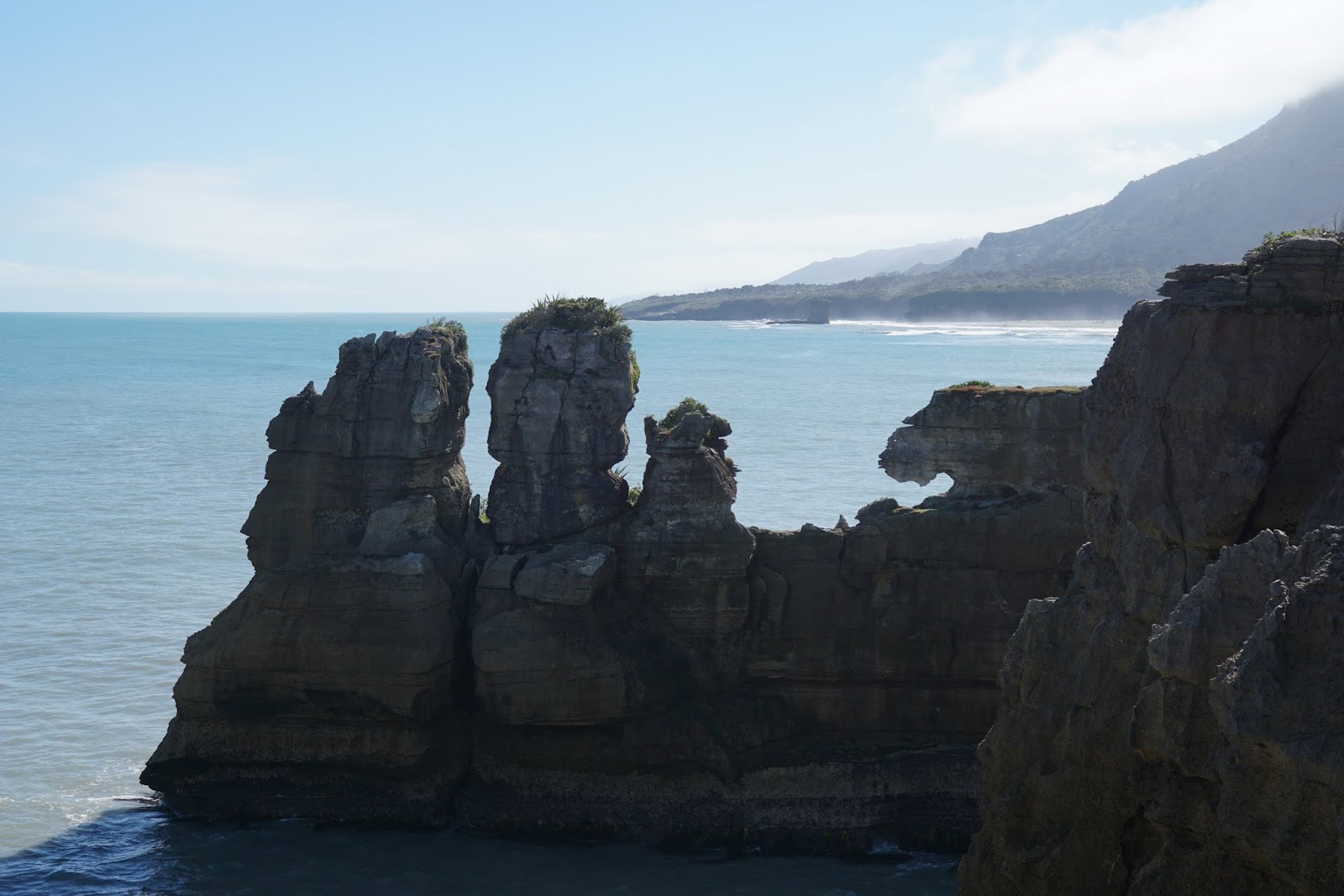
Further up the coast we visited the blue waters of Hokitika Gorge, walked through the bush along the shores of Lake Kaniere (Sally went for an early morning swim!) and saw the unusual pancake rock formations at Punakaiki Rocks. The countryside was lush and green due to so much rain and full of dairy farms. As we left the coast we headed along the powerful Buller River marvelling at the gorge along the way before stopping for the night at Lyell. This is the location of an old gold mine and walking through the forest we found the cemetery of the first inhabitants and remains of a huge rock crushing machine. A long distance mountain bike track called the Old Ghost Road starts here, but unfortunately we didn't have time for it on this trip. We also made friends with a South Island Robin who was very inquisitive hopping right up to us on the path and even trying to peck at our shoes to determine if they were edible.

Ripples in Lake Kaniere

Punakaiki Rocks

Next we headed to the beach town of Marahau on the north coast of the island. The tidal range here is huge and the sea is hundreds of metres away from the shore at low-tide. As the tide turns you can watch the water continuously crawling along the beach as it comes in. We spent a day walking along part of the Abel Tasman Great Walk in the national park of the same name. We caught a water taxi 15km along the coast and then spent the day walking back, exploring streams and beaches along the way. The water taxi itself was particularly exciting as we all got on board the boat at the taxi office whilst it was still on the back of it's trailer. A tractor then towed us to the waterfront and reversed us into the sea.

Ben with the tractor

Golden sands of Te Pukata beach

Whilst in the area we explored a different part of the coastline in a Maori waka (canoe). It was a great way to see the national park from the sea and to learn a bit more about Maori culture and history from our charismatic guide. 

Fiona with our waka

Ross (who we had stayed with in Christchurch) invited us to stay with him at his holiday home in Ruby Bay, which is very close to Abel Tasman National Park. The house is in a stunning location on a hilltop looking out over the bay towards Nelson with a beautiful garden. Ross treated us to a tour of the local area including vineyards, the trendy village of Mapua, the old fishing port of Motueka and the 'Resurgence'. Here a river just appears out of the ground in a deep pool and Sally once again went for a swim in the freezing water. Saying our goodbyes to Ross we headed south from Ruby Bay to return to Christchurch where our campervan adventure ended.

We had a great time on our 'South Island highlights tour' with Sally and Ian - and it was a real treat having the campervan with handy cups of tea at a moments notice whenever we stopped somewhere. It had also felt particularly luxurious to have not had to unpack and repack our bags for a whole 3 weeks (luckily everything still fitted in)! However, all good things must come to an end, and a smaller vehicle was calling us to explore the South Island further and fill in the gaps. 


Wednesday, 12 April 2017

New Zealand Part I - Auckland & Christchurch

We arrived in New Zealand’s largest city, Auckland, on a sunny summer afternoon at the end of January. (It still feels odd writing that January is summer!) A quick trip to the supermarket to stock up with supplies for a few days was a particular highlight of the day as they sold both cheese (good cheese is hard to find in South America) and the NZ version of Weet-a-bix inventively named ‘Weetbix’.

Each region of New Zealand has it’s own local public holiday every year in addition to the usual national ones. Fortunately for us our time in Auckland coincided with Auckland Day. There was a free festival down in the harbour involving tugboat rides, tours of a Navy ship, street entertainers and much more. We got to sit in the pilot’s seat of a helicopter, watched loads of yachts sailing in the harbour and enjoyed a free concert by ‘Auckestra’, Auckland’s Symphony Orchestra one evening.  They played film theme music culminating in fireworks set to the Star Wars theme. A large area of the festival was dedicated to Maori culture and music. It was really interesting to listen to both traditional and contemporary Maori dance, music and singing.  Spending a few hours there gave us a good introduction to their culture and the relationship between them and the rest of the population.


Yachts in Auckland Harbour


Traditional Maori songs

Auckland is built on a volcanic plain with many extinct volcanoes sticking up as hills throughout the area. We spent a day visiting the newest of these, Rangitoto, which created an island in the bay about 600 years ago. The view from the top back towards the city was impressive. Whilst in the city we took the opportunity to meet up with Adam, who we met in South Africa a few years ago, who now lives there. It was fun to catch up, try some local beers and find out about life in New Zealand.

View of Auckland from Rangitoto


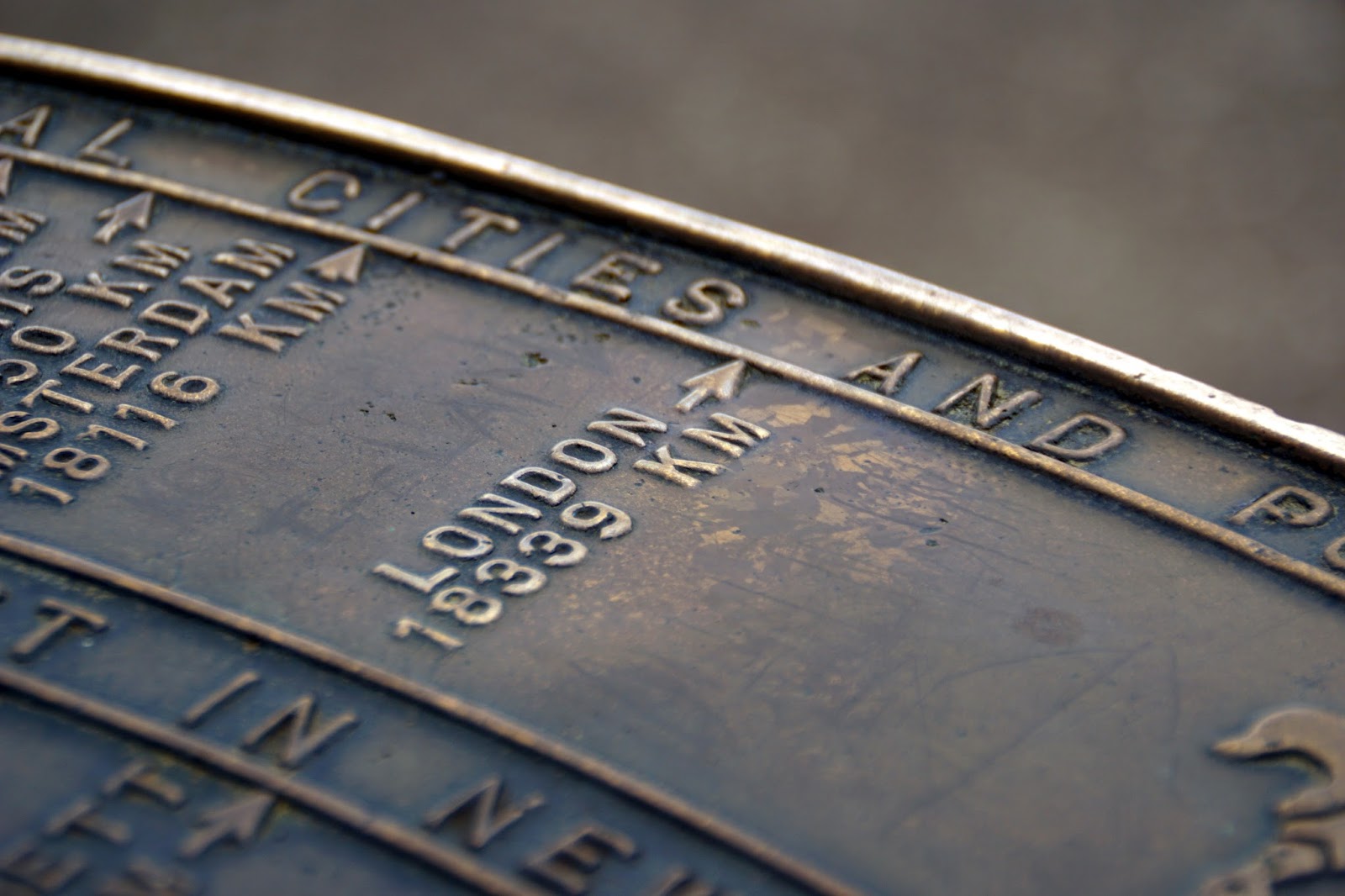
A long way from home

After 5 days in Auckland we took a flight down to Christchurch on the South Island where we were due to meet up with Fiona’s parents.  We decided to hire a car for a few days to allow us to explore the area better, as public transport is pretty infrequent outside of the main urban areas. It was the first time we had driven in over 6 months, but fortunately we hadn’t forgotten how. Our first night was spent in a hostel in the centre of the city giving us a chance to see the damage from the two earthquakes. There are lots of empty spaces where buildings once stood and the whole centre is still under reconstruction. It was pretty quiet in the evening as most businesses and people moved out to the suburbs in the aftermath of the quakes.

We then spent several days exploring around Christchurch visiting the port of Lyttleton, walking in the Port Hills and making a trip out onto the Banks Peninsula. The whole of the peninsula is formed from a long extinct volcano, resulting in a ridge line which slopes steeply down to the sea on either side. The drive along the top was along very steep windy roads with incredible views. We drove down into secluded bays with no other people around and vivid turquoise waters. At the end of the peninsula sits the picturesque village of Akaroa where we enjoyed a walk to the lighthouse and an early tea of fish and chips. During this time we stayed with Fiona’s relatives, Ross and Carol, who live in the city. They were very welcoming (Fiona hadn’t seen them since she was a child) and were full of information about the Christchurch earthquakes, life in New Zealand and what to see and do in the rest of our time on the South Island. It was great to stay in an actual house again after months in hostels and not have to be packing and unpacking every couple of days.


An empty bay on the Banks Peninsula

Hiking in the Port Hills

After a few days of being in Christchurch, Sally and Ian (Fiona's parents) arrived, having flown in from Sydney. It was very exciting to see them again after so long! We had some early evening champagne in the garden to celebrate our engagement, before starting to finalise our plans for our road trip over the next few weeks. 48 hours later, after lots of catching up and a bit of food shopping, we were all set to pick up our campervan and head off the next part of our adventure!  

Belated engagement celebrations!

Wednesday, 15 March 2017

Fiji

The Fijians certainly know how to welcome visitors to their country properly. We had never previously been serenaded by a three-piece band in colourful shirts whilst waiting in line to have our passports stamped. It made us feel better after a 12hr flight, arriving at 5am and realising we would never see the 18th January 2017 after crossing the International Date Line mid-flight. We made the most of the day and spent it touring around the city of Nadi and the local area. First we visited the largest Hindu temple in the southern hemisphere with its amazing brightly coloured murals. The British colonisers brought over many Indian labourers to work in the sugar-plantations in the 1870s and now a significant proportion of Fiji’s population is of Indian descent. Later we visited The Garden of the Sleeping Giant (botanical gardens with beautiful orchids) and some mud pools. Here we got into our swimming costumes and covered ourselves with thick mud before letting it dry and then jumping in natural hot pools to wash off.

Time for a wash
 
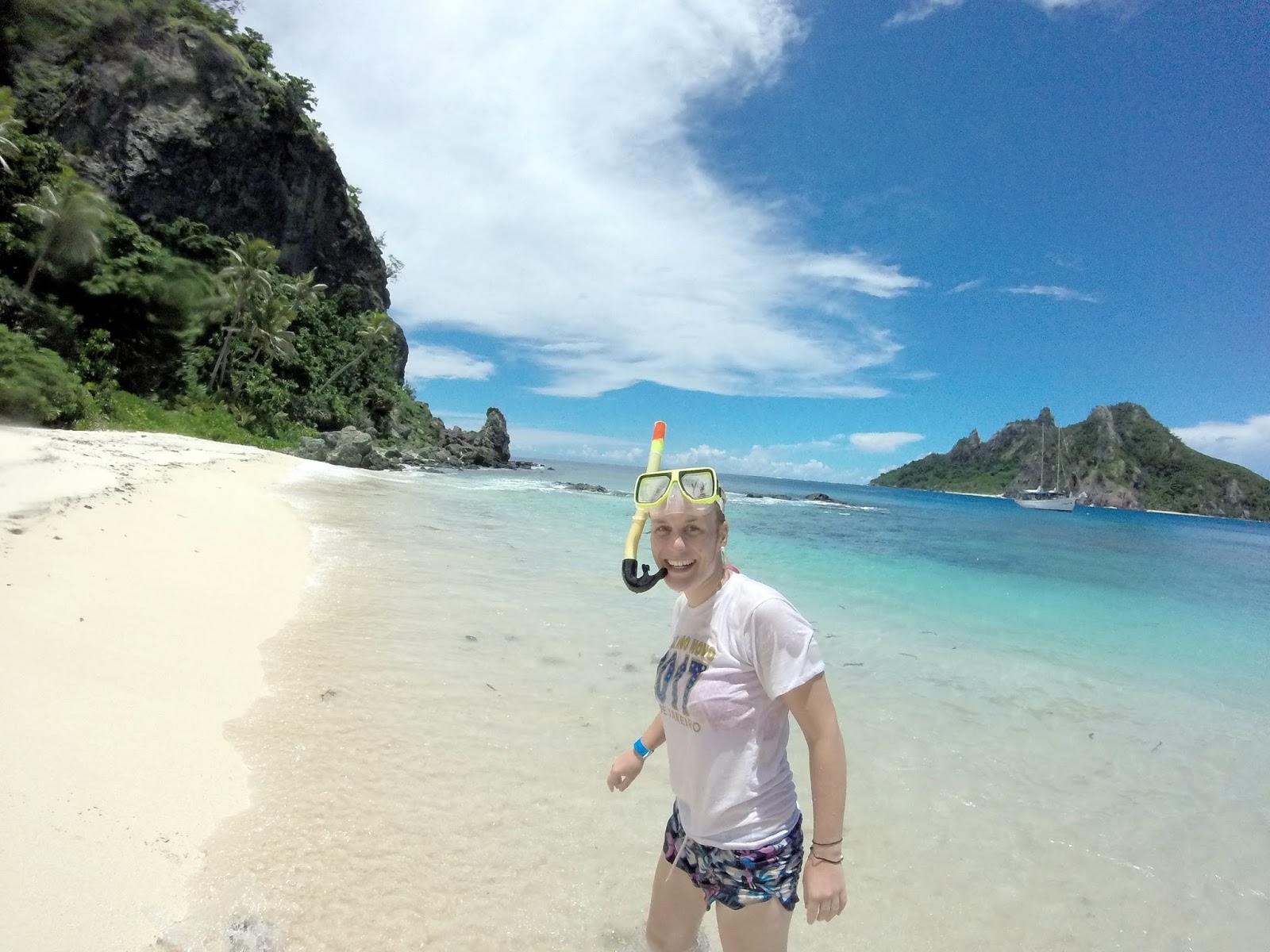
The majority of visitors to Fiji head to some of the smaller islands (Fiji is an archipelago of over 300 islands) where most of the resorts are based. Even the cheapest of these is quite expensive and we decided to save our money for later in the trip and opted for just a day trip to see a few of the tiny islands. We caught a catamaran ferry to Mana island and boarded a sail boat for the day’s adventure. Several tiny islands we sailed past were little more than a group of trees and a beach. They looked like the typical ‘desert islands’ described in books. Indeed the Tom Hanks film castaway was filmed on Mondriki island, which we stopped at for snorkelling. Unfortunately we didn’t find Wilson (sorry if you’ve not seen the film), but we did enjoy the pristine white sands, crystal clear waters and seeing lots of colourful fish.

Snorkelling off Mondriki Island

Not quite Titanic, but it'll do

 Everyone in Fiji seems very relaxed, welcoming and the pace of life is slow. Our tour guide on the first day introduced us to the concept of ‘Fiji time’ and the motto ‘No hurry…no worry’. It is such a difference from the busy pace of life back home and we could certainly learn something from the Fijians. Our guide did share his frustration that when occasionally things do need to be done quickly, problems tend to occur and opportunities can be missed.
 We spent one day in the capital of Suva, but there is not much to do for a tourist except visit a forest park with natural swimming pools and a huge rope swing. The majority of our time in Fiji was spent at a hostel called The Beachouse on the southern ‘Coral’ coast of the main island. To get there we caught a bus from Suva along the coast road, which almost goes along the beach with great views of the sands and turquoise sea. After over 100 buses we finally had our second transport mishap (the first being the breakdown of the very first bus in Colombia).  The luggage compartment under the bus came open as we hurtled along the main road and Ben’s backpack fell out. Fortunately Fiona was sat above the door that opened and saw it out the window so we got the bus to pull over quickly. One of the locals at the front of the bus jumped out before us and ran back to get my bag.  Nothing was broken or had come out the backpack, but it had sustained quite a lot of minor rips and superficial damage as it bounced along the gravel at the side of the road. Several stiches later and the holes had been closed up. It doesn’t look so new anymore, but now looks like a backpack that has been round the world.

One of many amazing beaches

Days at The Beachouse started with yoga on the terrace overlooking the sea before a breakfast of eggs, sausages, toast and cereals (and baked beans!). The rest of the day was spent sea kayaking, snorkelling, swimming or just reading a book in a hammock on the beach. Our ten-day stopover in Fiji really was paradise. Next stop 3 months in New Zealand…

Sunset on the Coral Coast

Plenty of time for relaxation

We learnt (and forgot) how to make this from a coconut palm leaf


Sunday, 5 March 2017

Los Angeles

Two 7hr flights later and we arrived in Los Angeles to experience winter for 2016/17. It turned out that the cheapest way to get across the Pacific ocean from South America was to first fly to LA and then on to Fiji so that's what we did and enjoyed a 48hr stop over in the USA. It also turned out that winter in Los Angeles means sunshine and t-shirt weather.

Early morning surfing on Venice Beach

Our first morning started very early due to the 6hr time difference from Rio, but the pancake breakfast with lots of syrup included at the hostel made up for this. We were staying in Venice Beach at a hostel right on the boardwalk so enjoyed a quiet walk along the beach and canals before most people were up and about. The only other people on the beach before 8am were joggers, dog-walkers and surfers catching a morning wave before heading off to work. Later in the morning we headed over to Santa Monica Pier and then into the town itself for some lunch.

Mmmm Reese's Peanut Butter Cups & Chocolate Fudge cheesecake

By the time we had finished lunch at The Cheesecake Factory, the beach and famous boardwalk between Santa Monica and Venice Beach had come to life. We slowly wandered back towards the hostel taking in all the sights and doing some serious people watching. To give you a flavour of the diverse range of activities being carried out here is a short list: Roller skating, cycling, walking, running, surfing, beach volleyball, football, weight lifting, tennis and most impressive were the group practising slack-line walking. The shops along the front sell a wide range of products including tattoos, t-shirts, art, fast-food and even 'medicinal' marijuana.

Amazing slack line skills

On our second day we went on a open top bus tour of Hollywood and Beverly Hills. We spent a fun hour or so finding our favourite actors' and singers' stars on the walk of fame. After 5 months in South America we experienced serious culture shock walking around downtown Santa Monica and driving around Beverly Hills. Yes there is wealth on display in the big cities like Buenos Aires and Santiago, but the wealth is far more obvious and widespread in a rich LA suburb. Amongst the expensive cars, designer clothes, gourmet food and high-end shops (all summed up by the huge glass fronted Apple store) we felt we had come a long way from the busy streets of Bogota or La Paz. 48hours was enough for us and we were ready to cross the Pacific to explore the only inhabited continent neither of us had yet visited.......

Hollywood Walk of Fame

Someone is not too popular around here

Saturday, 28 January 2017

Brazil

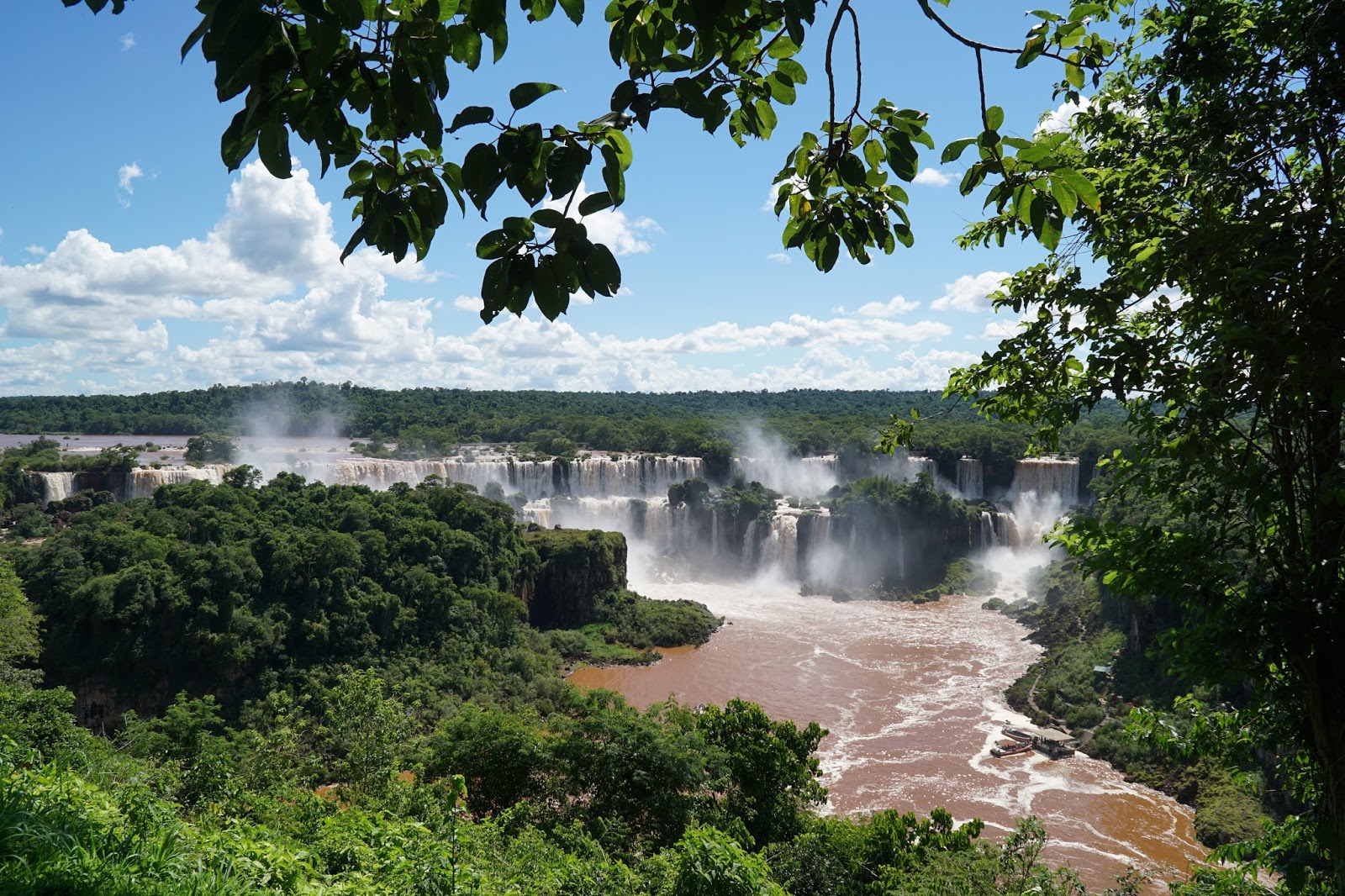
The Iguazu Falls (Spanish spelling) are a huge series of cataracts on the Iguazu river forming the border between Argentina and Brazil. They form the largest waterfall system in the world with a edge of 2.7km, although a series of small islands break up the flow into a number of smaller falls. We visited both sides of the falls starting with the Argentine side, which allows you to get a close up view of the majority of the falls. The whole area is inside a national park and walking through it to get to the falls we saw a huge array of wildlife. Colourful butterflies, small monkeys, lizards and coatis (a small racoon like creature) were everywhere. Long metal walkways stretch out over the river linking many of the small islands and allowing you to get right to the edge of the drop. About half of the water falls in a U-shaped 700m section known as the Devil's Throat. We could stand on a tiny island at the edge looking down into the abyss. It was very loud and we got very wet in the mist which rises well above the river despite being generated over 80m below. It was very refreshing in the intense summer sun. The rest of the day was spent enjoying the rest of the park and walking down to the bottom of the falls to see them from a different angle. It is very impressive looking up at the wall of water whilst again getting soaked through. 

Devil's Throat from the walkway to the edge

Fiona at the bottom of one of the falls

The next day we crossed the border into Brazil and headed to the national park on that side of the river to visit the Iguaçu Falls (Portuguese spelling). From this side of the river we got great panoramic view of all the falls at the same time. At the Devil's Throat there is again a walkway out onto the edge, but on the Brazilian side it sticks out half way down the drop so the wall of water was above and below us. The combination of sun and mist made for an impressive rainbow that almost made a full circle.

Looking across to Argentina from Brazil

Devil's Throat from the other side

So much water!

Before leaving the area we visited a bird sanctuary close the falls. Here they try to rehabilitate birds rescued from trafficking and hopefully release them again, but also provide a home to those unable to re-enter the wild. The highlights were walking through aviaries with Toucans and Macaws. They were such colourful and amazing birds and it was great to be able to get so close to them.

Toucan

One of many colourful macaws

Another long bus journey including a 6 hour wait in a bus station and some confusion owing to our lack of Portuguese language skills saw us arriving in Campo Grande, the gateway to The Pantanal. We had booked a 3 day tour of the huge wetland area over Christmas. We had decided that we needed to keep busy over the festive period as most places shut down and we would just miss home even more with nothing to do. We started our tour on Christmas Eve getting a lift with the owner of the company, Gil, and his wife to our lodge inside the Pantanal. We were staying in a room in a small chalet on huge stilts to ensure it stayed dry during the flood season, which was just starting when we were there. The Pantanal is the world's largest tropical wetland and floods every year with up to 80% of the area being covered with water. This means the wildlife congregates on the small islands left making it much easier to see them. At that point the whole area is only navigable by boat. That afternoon we went out on a boat trip to see what we could find. We saw howler monkeys, caiman, iguanas, storks, capybara, kingfishers, heron, toucans and many other species of birds. We also enjoyed a spectacular sunset before trying to spot jaguars with a huge flashlight, but with no luck.

Howler monkey

Christmas celebrations in Brazil are fairly small and limited to a big meal with family on Christmas Eve with presents exchanged at midnight. We joined in the meal with the owners and staff at the lodge, but it was very different to what we are used to. We spent Christmas morning canoeing down the river in search of more wildlife and enjoying drifting peacefully downstream. That afternoon we moved to another lodge on a farm further into the Pantanal and went horse-riding around their land. The horses were well behaved and followed each other in a line on the hour long walk sometimes wading through flooded areas up to their bellies. Despite initial panic at being atop a vehicle with a mind of it's own, Fiona even managed to enjoy it and made friends with her horse Shakira. The weather was very hot and humid so most activities took place early in the morning or around sunset with a much needed siesta in the middle of the day.

Fiona on Shakira

Other activities included a bush walk around the area, a jeep safari and piranha fishing. This involved wading into a lagoon up to our waists and fishing with a line and hook on a bamboo pole with raw beef as bait. Not only were the piranha swimming all around us (not a problem as these species wouldn't eat a human) but a couple of caiman were very interested in our bait and watched us with just their eyes above the water less than a few metres away. This was very unnerving but our guide assured us they didn't see us as dinner and wouldn't attack unless they felt threatened. If any got too close he proceeded to hit the water in front of them with his fishing pole to scare them off. The fishing was surprisingly easy and we caught several quickly, keeping the largest for our dinner and releasing the smaller ones.

Mmmm...dinner

Once back in Campo Grande on 27th December we caught up with family to find out about the Christmas celebrations we had missed back home. We were sad to have missed out on seeing everyone with the usual food and festivities, but we feel that it is a price worth paying for our amazing year of adventures. Christmas will happen again next year.

Ben's Christmas present

Our last overnight bus journey in South America took us to Rio de Janeiro where we celebrated New Year's Eve on Copacbana beach with 2 million other people. It is traditional to wear white to the party on the beach to symbolise a fresh start to the year, so we purchased 'Feliz Ano Novo 2017' t-shirts from a street vendor before heading to the beach. We had to buy special metro tickets in advance with a timed slot to avoid chaos on the underground system with so many people trying to arrive and leave at the same time.

Feliz Ano Novo

We arrived about 8pm, found a good spot in one of the less crowded areas of the beach and soaked up the atmosphere with a couple of beers. We watched as 4 huge cruise liners jostled for the best positioned to watch the fireworks from out in the bay. As we approached midnight the beach got more and more busy until by the time the fireworks started it was standing room only. Impressive for a beach that is over 4km long! The fireworks were launched from several barges moored out in the bay and lasted for 15minutes. Apparently the display is normally longer and bigger but due to the economic crisis in Brazil the budget had been massively cutback, but it was the still best display either of us had ever seen. After the fireworks we walked along the beach enjoying the various mini-parties taking place with different music and Samba dancing.

Amazing fireworks

Whilst in Rio de Janeiro we also went on a walking tour of the historic downtown learning about the history of the city and Brazil, and visited the Christ the Redeemer statue. The views of the city from the statue were amazing, but as it's one of the most popular attractions the huge crowds spoiled it somewhat. We found that the best view of the statue was from a distance where you can see it looking out over the city.

Jesus

Next we left the intense heat and humidity of the city and headed down the coast to the small colonial town of Paraty for a week. It was still hot, but the breeze from the sea kept us cool enough to sleep, which was difficult it Rio. The town is very picturesque with cobbled streets, white-washed buildings and many colourful boats moored along the river and seafront. At high tide the streets flood meaning you have to stay on the pavement or wade through the water. This is part of the original design and was to wash the sewage out of the street into the sea. We enjoyed a quiet week at the beach, sea kayaking around some small islands, trying stand-up paddle boarding and eating in a few nice restaurants. We took one day trip on a boat to explore some of the more distant islands of the coast of Paraty. The small beaches we visited were idyllic with palm trees coming down to the clean white sand, and the water almost as warm as a bath. The trip also included unlimited Caipirinhas (the local cocktail).

Pretty houses in Paraty

Look at the colour of the water!

After a week on the beach we travelled back to Rio de Janeiro to see a few more of the sights without the huge New Year's crowds before catching our flight out of South America. We had rented another apartment via Airbnb right in Copacabana a couple of blocks back from the beach. We spent one day walking around the lagoon where the Olympic rowing and canoeing races were held and visited the botanical gardens nearby. Unfortunately the gardens don't look like they have been cared for too well in recent years and it was a bit of a disappointment as they have the reputation as being amongst the best in the world. During a bike ride along the Copacabana and Ipanema beachfronts the skies opened and we got caught in the heaviest rain I have ever experienced. Within minutes we were completely drenched and there was so much water that the drains couldn't cope. The streets quickly flooded and we had to cycle and wade through several inches of water. Our last tourist activity was to catch the cable car up the large rock known as Sugarloaf. We went up at sunset so enjoyed views over the city and beaches in both daylight and the dark.

View from Sugarloaf

We couldn't leave Brazil without visiting a Rodizio restaurant, so we went on our last night as a farewell South America meal. This is essentially and 'all you can eat' meat buffet. After filling your plate with lots of tasty things from the unlimited salad bar, the waiters circulate around the tables with huge steaks, sausages, chickens etc on big spears, which they then carve small pieces off onto your plate. The meat was very good and we got very full. The following morning we headed to the airport to catch a 6hr flight back to Bogotá and then a 7hr flight to Los Angeles. Our South American adventure was over, but our Australasian one was about to begin.....